


Page 138 - (DK Eyewitness) Travel Guide - Spain
P. 138
136 NOR THERN SP AIN
Environs
Basque Country, The Monasterio de Nuestra
Navarra and La Señora de Irache, 3 km (2 miles)
Rioja’s Fiestas southwest of Estella, was a
Benedictine monastery which
Los Sanfermines (6–14 Jul), shel tered pilgrims on their way
Pamplona (Navarra). to Santiago. The church is mainly
In the famous encierro Transitional Gothic in style, but it
(bullrunning) six bulls are has Romanesque apses and a
released at 8am each cloister in Plateresque style. It is
morning to run from their capped by a remarkable dome.
corral through the narrow, A bodega next to the mon
cobbled streets of the Old astery provides pilgrims with
Town. On the last night of
this weeklong, nonstop wine from a tap in a wall.
festival, crowds with candles A small road branches off the
sing Basque songs in the NA120 north of Estella and leads
main square. The event to the Monasterio de Iranzu,
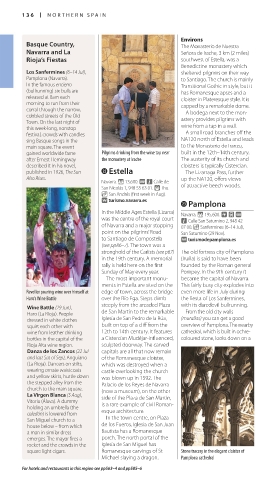
gained worldwide fame Pilgrims drinking from the wine tap near built in the 12th–14th century.
after Ernest Hemingway the monastery at Irache The auster ity of its church and
described it in his novel, clois ters is typically Cistercian.
published in 1926, The Sun s Estella The Lizarraga Pass, further
Also Rises. up the NA120, offers views
Navarra. * 13,600. @ n Calle de
San Nicolás 1, 948 55 63 01. ( Thu. of attractive beech woods.
_ San Andrés (first week in Aug).
∑ turismo.navarra.es
d Pamplona
In the Middle Ages Estella (Lizarra) Navarra. * 195,600. ~ £ @
was the centre of the royal court n Calle San Saturnino 2, 948 42
of Navarra and a major stopping 07 00. _ Sanfermines (6–14 Jul),
point on the pilgrims’ Road San Saturnino (29 Nov).
to Santiago de Compostela ∑ turismodepamplona.es
(see pp86–7). The town was a
stronghold of the Carlists (see p67) The old fortress city of Pamplona
in the 19th century. A memorial (Iruña) is said to have been
rally is held here on the first founded by the Roman general
Sunday of May every year. Pompey. In the 9th century it
The most important monu became the capital of Navarra.
ments in Estella are sited on the This fairly busy city explodes into
Reveller pouring wine over himself at edge of town, across the bridge even more life in July during
Haro’s Wine Battle over the Río Ega. Steps climb the fiesta of Los Sanfermines,
Wine Battle (29 Jun), steeply from the arcaded Plaza with its daredevil bullrunning.
Haro (La Rioja). People de San Martín to the re markable From the old city walls
dressed in white clothes Iglesia de San Pedro de la Rúa, (murallas) you can get a good
squirt each other with built on top of a cliff from the overview of Pamplona. The nearby
wine from leather drinking 12th to 14th century. It features cathedral, which is built in ochre
bottles in the capital of the a Cistercian Mudéjarinfluenced, coloured stone, looks down on a
Rioja Alta wine region. sculpted doorway. The carved
Danza de los Zancos (22 Jul capitals are all that now remain
and last Sat of Sep), Anguiano of the Romanesque cloister,
(La Rioja). Dancers on stilts, which was destroyed when a
wearing ornate waistcoats castle overlooking the church
and yellow skirts, hurtle down was blown up in 1592. The
the stepped alley from the Palacio de los Reyes de Navarra
church to the main square. (now a museum), on the other
La Virgen Blanca (5 Aug), side of the Plaza de San Martín,
Vitoria (Álava). A dummy
holding an umbrella (the is a rare example of civil Roman
celedón) is lowered from esque architecture.
San Miguel church to a In the town centre, on Plaza
house below – from which de los Fueros, Iglesia de San Juan
a man in similar dress Bautista has a Roman esque
emerges. The mayor fires a porch. The north portal of the
rocket and the crowds in the Iglesia de San Miguel has
square light cigars. Romanesque carvings of St Stone tracery in the elegant cloister of
Michael slaying a dragon. Pamplona cathedral
For hotels and restaurants in this region see pp563–4 and pp585–6
136-137_EW_Spain.indd 136 26/09/17 11:53 am

