


Page 359 - (DK Eyewitness) Travel Guide - Spain
P. 359
C ASTILLA Y LEÓN 357
7 León
León. * 131,700. £ @ n Plaza
Regla 2, 987 23 70 82. ( Wed & Sat.
_ San Juan and San Pedro (21–29
Jun), San Froilán (5 Oct).
∑ turismoleon.org
Founded as a camp for the
Romans’ Seventh Legion,
León became the capital of a
kingdom in the Middle Ages.
As such it played a central
role in the early years of the
Reconquest (see pp58–9).
The city’s most important
building – apart from its great
cathedral (see pp358–9) – is the
Colegiata de San Isidoro, built
into the Roman walls which
encircle the city. A sep arate
entrance leads through to the
Romanesque Panteón Real
(Royal Pantheon), the last resting
place of more than 20 monarchs.
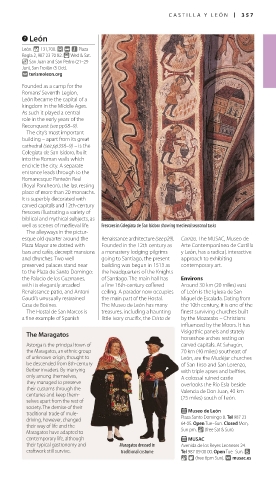
It is superbly decorated with
carved capi tals and 12th-century
frescoes illustrating a variety of
biblical and mythical subjects, as
well as scenes of medieval life. Frescoes in Colegiata de San Isidoro showing medieval seasonal tasks
The alleyways in the pictur-
esque old quarter around the Renais sance architecture (see p29). Carrizo. The MUSAC, Museo de
Plaza Mayor are dotted with Founded in the 12th century as Arte Contemporáneo de Castilla
bars and cafés, decrepit mansions a monastery lodging pilgrims y León, has a radical, interactive
and churches. Two well- going to Santiago, the present approach to exhibiting
preserved palaces stand near building was begun in 1513 as contemporary art.
to the Plaza de Santo Domingo: the headquarters of the Knights
the Palacio de los Guzmanes, of Santiago. The main hall has Environs
with its elegantly arcaded a fine 16th-century coffered Around 30 km (20 miles) east
Renaissance patio, and Antoni ceiling. A parador now occupies of León is the Iglesia de San
Gaudí’s unusually restrained the main part of the Hostal. Miguel de Escalada. Dating from
Casa de Botines. The Museo de León has many the 10th century, it is one of the
The Hostal de San Marcos is treasures, including a haunting finest surviving churches built
a fine example of Spanish little ivory crucifix, the Cristo de by the Mozarabs – Christians
influenced by the Moors. It has
The Maragatos Visigothic panels and stately
horseshoe arches resting on
Astorga is the principal town of carved capitals. At Sahagún,
the Maragatos, an ethnic group 70 km (40 miles) southeast of
of unknown origin, thought to León, are the Mudéjar churches
be descended from 8th-century of San Tirso and San Lorenzo,
Berber invaders. By marrying with triple apses and belfries.
only among themselves, A colossal ruined castle
they managed to preserve overlooks the Río Esla beside
their customs through the Valencia de Don Juan, 40 km
centuries and keep them- (25 miles) south of León.
selves apart from the rest of
society. The demise of their E Museo de León
traditional trade of mule-
driving, however, changed Plaza Santo Domingo 8. Tel 987 23
their way of life and the 64 05. Open Tue–Sun. Closed Mon,
Maragatos have adapted to Sun pm. & (free Sat & Sun).
contemporary life, although E MUSAC
their typical gastronomy and Maragatos dressed in Avenida de los Reyes Leoneses 24.
craftwork still survive. traditional costume Tel 987 09 00 00. Open Tue–Sun. 7
& 8 (free 6pm Sun). ∑ musac.es
356-357_EW_Spain.indd 357 26/09/17 11:02 am

