


Page 362 - (DK Eyewitness) Travel Guide - Spain
P. 362
360 CENTR AL SP AIN
8 Zamora most important monument is its The allegorical carvings of nuns
unique cathedral, a 12th-century and monks on the misericords
Zamora. * 65,300. £ @ n Plaza
de Arias Gonzalo, 980 53 36 94. ( structure built in Romanesque and arm rests were once con-
Tue. _ Semana Santa (Easter Week), style but with a number of later sidered risqué. The museum,
San Pedro (23–29 Jun). ∑ zamora- Gothic addi tions. The building’s off the cloisters, has a collection
turismo.com most eye-catching feature is its of 15th- and 16th-century
strik ing, scaly, hemispherical Flemish tapestries. These
Little remains of Zamora’s past as dome. Inside, there are superb illustrate biblical passages and
an important strategic frontier iron grilles and Mudéjar pulpits classical and military scenes.
town. In Roman times, it was surround Juan de Bruselas’ Nearby, several churches
on the Vía de la Plata (see p356), 15th-century choir stalls. ex hibit features characteristic
and during the Reconquest was of Zamora’s architectural style,
fought over fiercely. The city has notably multi-lobed arches
now expanded far beyond its and heavily carved portals.
original boundaries, but the The best are the 12th-century
old quarter contains a wealth Iglesia de San Ildefonso and the
of Romanesque churches. Iglesia de la Magdalena.
The ruins of the city walls, built Another reason for visiting
by Alfonso III in 893, are pierced by Zamora is for its lively Easter
the Portillo de la Traición (Traitor’s Week celebrations, when elab-
Gate), through which the orate pasos (sculpted floats) are
murderer of Sancho II passed in paraded in the streets. Other wise
1072. The 16th-century parador they can be admired in the
(see p570) is in an old palace Museo de Semana Santa.
with a Renaissance courtyard
adorned with coats of arms. Environs
Two other palaces, the Palacio The 7th-century Visigothic church
de los Momos and the Palacio del of San Pedro de la Nave, 23 km
Cordón, have ornately carved Peaceful gardens of the Colegiata de (14 miles) north west of Zamora,
façades and windows. Zamora’s Santa María in Toro is Spain’s oldest church. Carvings
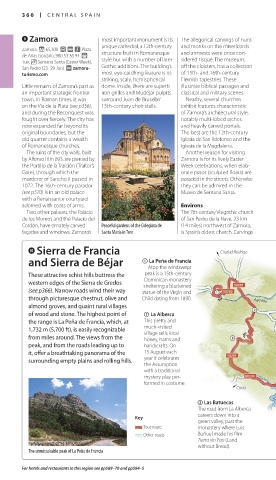
0 Sierra de Francia Ciudad Rodrigo
and Sierra de Béjar 1 La Peña de Francia
Atop the wind swept
These attractive schist hills buttress the peak is a 15th-century
Dominican monastery
western edges of the Sierra de Gredos sheltering a blackened
(see p366). Narrow roads wind their way statue of the Virgin and
through picturesque chestnut, olive and Child dating from 1890. J Agadón
almond groves, and quaint rural villages
of wood and stone. The highest point of 2 La Alberca
the range is La Peña de Francia, which, at This pretty and
1,732 m (5,700 ft), is easily recognizable much-visited
village sells local
from miles around. The views from the honey, hams and J
peak, and from the roads leading up to handi crafts. On Madronal
it, offer a breathtaking panorama of the 15 August each
surrounding empty plains and rolling hills. year it celebrates
the Assumption
with a traditional
mystery play per-
formed in costume.
Coria
3 Las Batuecas
The road from La Alberca
careers down into a
Key
green valley, past the
Tour route monastery where Luis
Other roads Buñuel made his film
Tierra sin Pan (Land
without Bread).
The unmistakable peak of La Peña de Francia
For hotels and restaurants in this region see pp569–70 and pp594–5
360-361_EW_Spain.indd 360 26/09/17 11:02 am

