


Page 430 - (DK Eyewitness) Travel Guide - Spain
P. 430
428 SOUTHERN SP AIN
Flamenco, the Soul of Andalucía
More than just a dance, flamenco is a rousing artistic expression
of the joys and sorrows of life. Although it has interpreters all
over Spain and even the world, it is a uniquely Andalucían art
form, traditionally performed by gypsies of the region. There are
many styles of cante (song) from different parts of Andalucía,
but no strict choreography – dancers improvise from basic
movements, following the rhythm of the guitar and their feelings.
Flamenco was neglected in the 1960s and 1970s, but had since
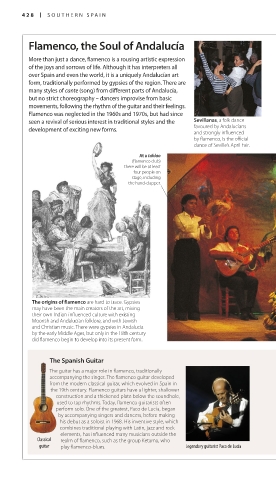
seen a revival of serious interest in traditional styles and the Sevillanas, a folk dance
favoured by Andalucíans
development of exciting new forms. and strongly influenced
by flamenco, is the official
dance of Seville’s April Fair.
At a tablao
(flamenco club)
there will be at least
four people on
stage, including
the hand-clapper.
The origins of flamenco are hard to trace. Gypsies
may have been the main creators of the art, mixing
their own Indian-influenced culture with existing
Moorish and Andalucían folklore, and with Jewish
and Christian music. There were gypsies in Andalucía
by the early Middle Ages, but only in the 18th century
did flamenco begin to develop into its present form.
The Spanish Guitar
The guitar has a major role in flamenco, traditionally
accompanying the singer. The flamenco guitar devel oped
from the modern classical guitar, which evolved in Spain in
the 19th century. Flamenco guitars have a lighter, shallower
construction and a thickened plate below the soundhole,
used to tap rhythms. Today, flamenco guitarists often
perform solo. One of the greatest, Paco de Lucía, began
by accompanying singers and dancers, before making
his debut as a soloist in 1968. His inventive style, which
combines traditional playing with Latin, jazz and rock
elements, has influenced many musicians outside the
Classical realm of flamenco, such as the group Ketama, who
guitar play flamenco-blues. Legendary guitarist Paco de Lucía
428-429_EW_Spain.indd 428 26/09/17 11:55 am

