


Page 431 - (DK Eyewitness) Travel Guide - Spain
P. 431
INTRODUCING SOUTHERN SP AIN 429
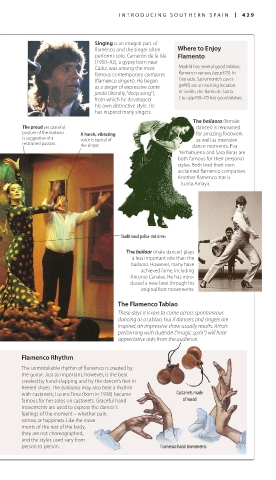
Singing is an integral part of
flamenco and the singer often Where to Enjoy
performs solo. Camarón de la Isla Flamento
(1950–92), a gypsy born near
Cádiz, was among the most Madrid has several good tablaos,
famous contemporary cantaores flamenco venues (see p325). In
(flamenco singers). He began Granada, Sacromonte’s caves
as a singer of expressive cante (p495) are an exciting location.
jondo (literally, “deep song”), In Seville, the Barrio de Santa
from which he developed Cruz (pp438–47) has good tablaos.
his own distinctive style. He
has inspired many singers.
The bailaora (female
The proud yet graceful dancer) is renowned
posture of the bailaora A harsh, vibrating for amazing footwork
is suggestive of a voice is typical of as well as intensive
restrained passion. the singer. dance moments. Eva
Yerbabuena and Sara Baras are
both famous for their personal
styles. Both lead their own
acclaimed flamenco companies.
Another flamenco star is
Juana Amaya.
Traditional polka-dot dress
The bailaor (male dancer) plays
a less important role than the
bailaora. However, many have
achieved fame, including
Antonio Canales. He has intro
duced a new beat through his
original foot movements.
The Flamenco Tablao
These days it is rare to come across spontaneous
dancing at a tablao, but if dancers and singers are
inspired, an impressive show usually results. Artists
performing with duende (“magic spirit”) will hear
appreciative olés from the audience.
Flamenco Rhythm
The unmistakable rhythm of flamenco is created by
the guitar. Just as important, however, is the beat
created by handclapping and by the dancer’s feet in
heeled shoes. The bailaoras may also beat a rhythm
with castanets; Lucero Tena (born in 1938) became Castanets made
famous for her solos on castanets. Graceful hand of wood
movements are used to express the dancer’s
feelings of the moment – whether pain,
sorrow, or happiness. Like the move
ments of the rest of the body,
they are not choreo graphed,
and the styles used vary from
person to person. Flamenco hand movements
428-429_EW_Spain.indd 429 26/09/17 11:55 am

