


Page 432 - (DK Eyewitness) Travel Guide - Spain
P. 432
430 SE VILLE
Introducing Seville
The capital of Andalucía is a compact city with a rich cultural
heritage. Conveniently, many of its principal sights can be
found within or very near the city centre, which is set on the
east bank of the Río Guadalquivir. Most visitors head straight
for the cathedral and La Giralda, Real Alcázar and Museo de
Bellas Artes. Among other highly popular monuments are
the beautiful Renaissance palace of Casa de Pilatos and
Seville’s bullring, the Plaza de Toros de la Maestranza.
There are, however, many other churches, monuments
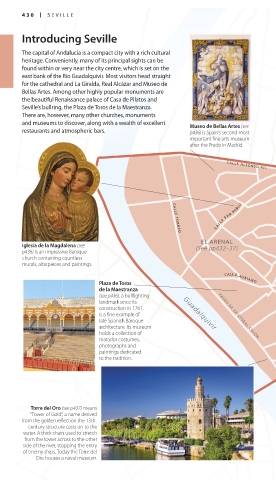
and museums to discover, along with a wealth of excellent Museo de Bellas Artes (see
restaurants and atmospheric bars. p436) is Spain’s second most
important fine arts museum
after the Prado in Madrid. CALLE LARAÑA
C AL L E AL FO N SO X II
C A L L E S A N PA BLO CA LLE SI E RP ES C UE S TA D EL R O SA R I O CALLE RE C A R EDO
CA L L E TO R NE O
EL ARENAL
Iglesia de la Magdalena (see (See pp432–37)
p436) is an impressive Baroque
church containing countless SANTA CRUZ
murals, altarpieces and paintings. (See pp438–447) C A L L E SA N J OS É
Plaza de Toros C ALL E AD R IA NO
de la Maestranza
(see p436), a bullfighting AV. D E LA C O N S T I T UCI ÓN AV. D E ME NÉ NDE Z P E LAY O
landmark since its
construction in 1761,
is a fine example of Guadalquivir PA S E O DE C R I S TÓ BAL C O LÓ N
late Spanish Baroque
architecture. Its museum
holds a collection of
matador costumes,
photographs and
paintings dedicated
to the tradition. C AL L E SAN FE R N A ND O
Torre del Oro (see p437) means
“Tower of Gold”, a name derived
from the golden reflection the 13th-
century structure casts on to the
water. A thick chain used to stretch
from the tower across to the other
side of the river, stopping the entry
of enemy ships. Today the Torre del
Oro houses a naval museum.
430-431_EW_Spain.indd 430 26/09/17 11:55 am

