


Page 45 - (DK Eyewitness) Travel Guide - Spain
P. 45
A POR TR AIT OF SP AIN 43
During Los Sanfermines (see
p136) in Pamplona in July,
young people run through the
streets in front of a herd of bulls.
The Virgin of Carmen,
who is revered as the patron
of fishermen, is honoured
in many ports on 16 July.
The important Catholic
holiday of Assumption Day,
15 August, is marked by a huge
number and variety of fiestas.
Autumn Fiestas
There are few fiestas in
autumn, but in most wine
regions the grape harvest is
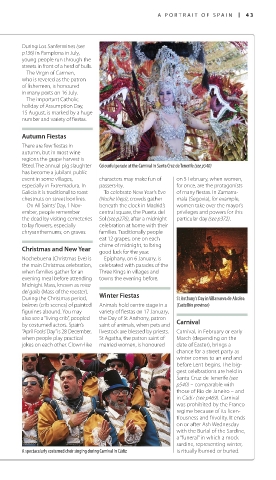
fêted. The annual pig slaugh ter Colourful parade at the Carnival in Santa Cruz de Tenerife (see p540)
has become a jubilant public
event in some villages, characters may make fun of on 5 February, when women,
especially in Extremadura. In passersby. for once, are the protagonists
Galicia it is traditional to roast To celebrate New Year’s Eve of many fiestas. In Zamarra
chestnuts on street bonfires. (Noche Vieja), crowds gather mala (Segovia), for example,
On All Saints’ Day, 1 Nov beneath the clock in Madrid’s women take over the mayor’s
ember, people remember central square, the Puerta del privileges and powers for this
the dead by visiting cemeteries Sol (see p276), after a midnight particular day (see p372).
to lay flowers, especially celebration at home with their
chrysanthemums, on graves. families. Traditionally people
eat 12 grapes, one on each
chime of midnight, to bring
Christmas and New Year good luck for the year.
Nochebuena (Christmas Eve) is Epiphany, on 6 January, is
the main Christmas celebration, celebrated with parades of the
when families gather for an Three Kings in villages and
evening meal before attending towns the evening before.
Midnight Mass, known as misa
del gallo (Mass of the rooster).
During the Christmas period, Winter Fiestas St Anthony’s Day in Villanueva de Alcolea
belenes (crib scenes) of painted Animals hold centre stage in a (Castellón province)
figurines abound. You may variety of fiestas on 17 January,
also see a “living crib”, peo pled the Day of St Anthony, patron
by costumed actors. Spain’s saint of ani mals, when pets and Carnival
“April Fools’ Day” is 28 December, live stock are blessed by priests. Carnival, in February or early
when people play practical St Agatha, the patron saint of March (depending on the
jokes on each other. Clownlike married women, is honoured date of Easter), brings a
chance for a street party as
winter comes to an end and
before Lent begins. The big
gest celebrations are held in
Santa Cruz de Tenerife (see
p540) – comparable with
those of Rio de Janeiro – and
in Cádiz (see p469). Carnival
was prohibited by the Franco
regime because of its licen
tiousness and frivolity. It ends
on or after Ash Wednesday
with the Burial of the Sardine,
a “funeral” in which a mock
sardine, representing winter,
A spectacularly costumed choir singing during Carnival in Cádiz is ritually burned or buried.
042-043_EW_Spain.indd 43 26/09/17 11:52 am

