


Page 42 - (DK Eyewitness) Travel Guide - Spain
P. 42
40 INTRODUCING SP AIN
The Bullfighting Tradition
Bullfighting is a sacrificial ritual in which men (and a
few women) pit themselves against a bull bred for the
ring. In this “authentic religious drama”, as poet García
Lorca described it, spectators experience the fear and
exaltation felt by the matador. Bullfights today, how
ever, are often debased by practices that weaken the
bull, such as shaving its horns. Opinion is divided on
this, with a growing number of Spaniards opposing
the tradition. Catalonia banned bullfighting on Plaza de Toros de la Maestranza, Seville.
grounds of cruelty in 2010. The ban was reversed by This ring is regarded, with Las Ventas in
Madrid, as one of the top venues for
Spain’s constitutional court in 2016 but Catalonia’s bullfighting in Spain.
regional government continues to ignore this ruling.
Many still regard the toreo, the art of bull fighting, as
an essential part of their cultural heritage.
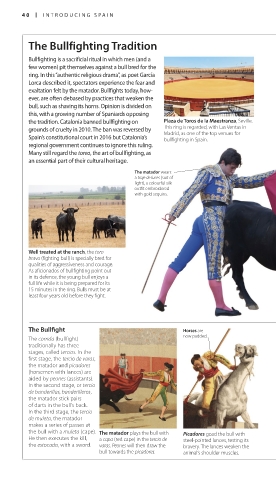
The matador wears
a traje de luces (suit of
light), a colourful silk
outfit embroidered
with gold sequins.
Well treated at the ranch, the toro
bravo (fighting bull) is specially bred for
qualities of aggressiveness and courage.
As aficionados of bullfighting point out
in its defence, the young bull enjoys a
full life while it is being prepared for its
15 minutes in the ring. Bulls must be at
least four years old before they fight.
The Bullfight Horses are
The corrida (bullfight) now padded.
traditionally has three
stages, called tercios. In the
first stage, the tercio de varas,
the matador and picadores
(horsemen with lances) are
aided by peones (assistants).
In the second stage, or tercio
de banderillas, banderilleros,
the matador stick pairs
of darts in the bull’s back.
In the third stage, the tercio
de muleta, the matador
makes a series of passes at
the bull with a muleta (cape). The matador plays the bull with Picadores goad the bull with
He then executes the kill, a capa (red cape) in the tercio de steel-pointed lances, testing its
the estocada, with a sword. varas. Peones will then draw the bravery. The lances weaken the
bull towards the picadores. animal’s shoulder muscles.
040-041_EW_Spain.indd 40 26/09/17 11:52 am

