


Page 40 - (DK Eyewitness) Travel Guide - Spain
P. 40
38 INTRODUCING SP AIN
Literary Spain two nobles and a scheming
go-between. This was an age
The best-known work of Spanish literature, Don Quixote in which tales of chivalry were
is considered the first modern novel, but Spain has also popular.
produced many major works over the last 2,000 years.
The Roman writers Seneca, Lucan and Martial were born
in Spain. Later, the Moors developed a flourishing, but
now little-known, literary culture. Although Spanish
(Castilian) is the national tongue, many enduring works
have been written in the Galician and Catalan regional
languages. Basque literature, hitherto an oral culture, is
a more recent development. Many foreign writers, such
as Alexandre Dumas, Ernest Hemingway and Karel
Capek, have written accounts of their travels in Spain.
Under his supervision a team
Middle Ages of Jews, Christians and Arabs
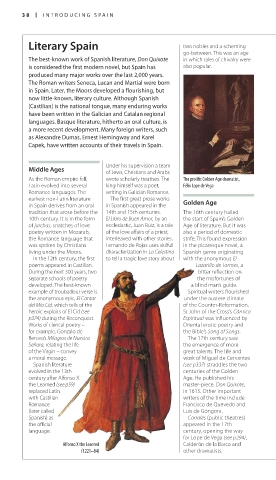
As the Roman empire fell, wrote scholarly treatises. The The prolific Golden Age dramatist,
Latin evolved into several king himself was a poet, Félix Lope de Vega
Ro mance languages. The writ ing in Galician Romance.
earliest non-Latin literature The first great prose works
in Spain derives from an oral in Spanish appeared in the Golden Age
tradition that arose before the 14th and 15th centuries. The 16th century hailed
10th century. It is in the form El Libro de Buen Amor, by an the start of Spain’s Golden
of jarchas, snatches of love ec clesiastic, Juan Ruiz, is a tale Age of literature. But it was
poetry written in Mozarab, of the love affairs of a priest, also a period of domestic
the Romance language that interleaved with other stories. strife. This found expression
was spoken by Christians Fernando de Rojas uses skil ful in the picaresque novel, a
liv ing under the Moors. characterization in La Celestina Spanish genre originating
In the 12th century, the first to tell a tragic love story about with the anonymous El
poems appeared in Castilian. Lazarillo de Tormes, a
During the next 300 years, two bit ter reflection on
separate schools of poetry the misfor tunes of
developed. The best-known a blind man’s guide.
example of trouba dour verse is Spiritual writers flourished
the anonymous epic, El Cantar under the austere climate
del Mío Cid, which tells of the of the Counter-Reformation.
heroic exploits of El Cid (see St John of the Cross’s Cántico
p374) during the Recon quest. Espiritual was influenced by
Works of clerical poetry – Oriental erotic poetry and
for example, Gonzalo de the Bible’s Song of Songs.
Berceo’s Milagros de Nuestra The 17th century saw
Señora, relating the life the emergence of more
of the Virgin – convey great talents. The life and
a moral message. work of Miguel de Cervantes
Spanish literature (see p337) straddles the two
evolved in the 13th cen turies of the Golden
century after Alfonso X Age. He published his
the Learned (see p59) master-piece, Don Quixote,
replaced Latin in 1615. Other important
with Castilian writers of the time include
Romance Francisco de Quevedo and
(later called Luis de Góngora.
Span ish) as Corrales (public theatres)
the official appeared in the 17th
language. century, opening the way
for Lope de Vega (see p294),
Alfonso X the Learned Calderón de la Barca and
(1221–84) other dramatists.
038-039_EW_Spain.indd 38 26/09/17 11:52 am

