


Page 41 - (DK Eyewitness) Travel Guide - Spain
P. 41
A POR TR AIT OF SP AIN 39
Andalucía to make universal
statements in his poems
and plays, such as Yerma.
In the aftermath of the Civil
War, many intellectuals who
had backed the Republic were
forced into exile. The Franco
regime tried to create its own
propagandist culture. Yet the
finest literature of the period
was written in spite of
the political cli mate.
Camilo José Cela’s
La Colmena, a
description of
everyday life
in the hungry,
postwar city
of Madrid, set
a mood of
social realism
that inspired
other writers.
Don Quixote’s adventures portrayed by José Moreno Carbonero Since the
1960s, the novel
Nacionales. The heroine in has become
18th and 19th Centuries
Clarín’s La Regenta is undone increasingly
Influenced by the French by the re actionary prejudices popular due to the
Enlightenment, literature in of pro vincial town society. emergence of writers
the 18th century was seen as like Joan Benet, Julio
a way to educate the people. 20th Century Llamazares, Antonio
Such was the aim, for instance, Muñoz Molina, José
of Leandro Fernández de Writers at the turn of the century, Manuel Caballero
Moratín’s comedy El Sí de las including Pío Baroja (see p68), Bonald, Juan Marsé
Niñas. This period saw the Miguel de Unamuno and and the best-selling
development of journalism Antonio Machado, described Carlos Ruiz Zafón.
as well as the emergence of Spain as falling behind the The 20th and 21st Statue of
the essay as a literary form. rest of Europe. Ramón María centuries have also García Lorca
Ro manticism had del Valle-Inclán wrote witnessed a surge of
a short and late highly satirical plays great Spanish literature from
life in Spain. Don that created the Latin America. Prominent
Juan Tenorio, foundations authors include Jorge Luis
a tale of the of modern Borges, José Ángel Mañas,
legendary Spanish theatre. Javier Marías and Gabriel
irrepressible In poetry, the García Márquez.
Latin lover Nobel Prize
by José winner, Juan
Zorrilla, is the Ramón Jiménez,
best-known strived for pure-
Romantic play. ness of form.
The satirical José Zorrilla (1817–93) The so-called
essayist Larra stands “Generation of
out from his contem poraries 27” combined European
at the beginning of the 19th experimental art with Spain’s
century. Towards the end of the traditional literary subjects.
century, the novel became a The best-known of them is
vehicle for realistic portrayals the poet and play wright
of Spanish society. Benito Pérez Federico García Lorca who
Galdós, regarded by many to was executed by a Fas cist
be Spain’s great est novelist after firing squad in 1936 (see p71).
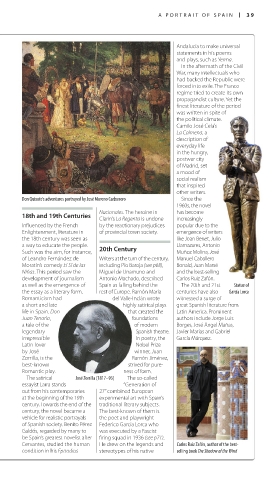
Cervantes, studied the human He drew on the legends and Carlos Ruiz Zafón, author of the best-
condition in his Episodios stereotypes of his native selling book The Shadow of the Wind
038-039_EW_Spain.indd 39 26/09/17 11:52 am

