


Page 482 - (DK Eyewitness) Travel Guide - Spain
P. 482
480 SOUTHERN SP AIN
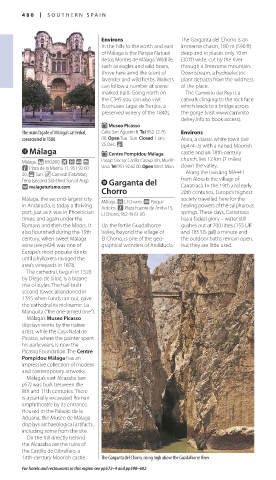
Environs The Garganta del Chorro is an
In the hills to the north and east immense chasm, 180 m (590 ft)
of Málaga is the Parque Natural deep and in places only 10 m
de los Montes de Málaga. Wild life, (30 ft) wide, cut by the river
such as eagles and wild boars, through a limestone mountain.
thrive here amid the scent of Downstream, a hydroelectric
lavender and wild herbs. Walk ers plant detracts from the wild ness
can follow a number of scenic of the place.
marked trails. Going north on The Caminito del Rey is a
the C345 you can also visit catwalk clinging to the rock face
Ecomuseo Lagar de Torrijos, a which leads to a bridge across
preserved winery of the 1840s. the gorge (visit www.caminito
delrey.info to book access).
E Museo Picasso
The main façade of Málaga’s cathedral, Calle San Agustín 8. Tel 952 12 76 Environs
consecrated in 1588 00. Open Tue–Sun. Closed 1 Jan, Álora, a classic white town (see
25 Dec. & pp474–5) with a ruined Moorish
u Málaga E Centre Pompidou Málaga castle and an 18th-century
Málaga. * 650,000. k £ @ g Pasaje Doctor Carillo Casaux s/n, Muelle church, lies 12 km (7 miles)
n Plaza de la Marina 11, 951 92 60 Uno. Tel 951 92 62 00. Open Wed–Mon. down the valley.
20. ( Sun. _ Carnival (Feb/Mar), Along the twisting MA441
Feria (second Sat–third Sun of Aug). i Garganta del from Álora is the village of
∑ malagaturismo.com Carratraca. In the 19th and early
Chorro 20th centuries, Europe’s highest
Málaga, the second-largest city Málaga. £ El Chorro. @ Parque society travelled here for the
in Andalucía, is today a thriving Ardeles. n Plaza Fuente de Arriba 15, healing powers of the sulphurous
port, just as it was in Phoenician El Chorro, 952 49 61 00. springs. These days, Carratraca
times, and again under the has a faded glory – water still
Romans and then the Moors. It Up the fertile Guadalhorce gushes out at 700 litres (155 UK
also flour ished during the 19th Valley, beyond the village of and 185 US gal) a minute and
century, when sweet Málaga El Chorro, is one of the geo- the outdoor baths remain open,
wine (see p424) was one of graph ical wonders of Andalucía. but they are little used.
Europe’s most popular drinks –
until phylloxera ravaged the
area’s vineyards in 1876.
The cathedral, begun in 1528
by Diego de Siloé, is a bizarre
mix of styles. The half-built
second tower, aban doned in
1765 when funds ran out, gave
the cathedral its nickname: La
Manquita (“the one-armed one”).
Málaga’s Museo Picasso
displays works by the native
artist, while the Casa Natal de
Picasso, where the painter spent
his early years, is now the
Picasso Foundation. The Centre
Pompidou Málaga has an
impressive collection of modern
and contemporary artworks.
Málaga’s vast Alcazaba (see
p57) was built between the
8th and 11th centuries. There
is a partially excavated Roman
amphitheatre by its entrance.
Housed in the Palacio de la
Aduana, the Museo de Málaga
displays archaeological artifacts,
including some from the site.
On the hill directly behind
the Alcazaba are the ruins of
the Castillo de Gibralfaro, a
14th-century Moorish castle. The Garganta del Chorro, rising high above the Guadalhorce River
For hotels and restaurants in this region see pp572–4 and pp598–602
480-481_EW_Spain.indd 480 26/09/17 11:56 am

