


Page 484 - (DK Eyewitness) Travel Guide - Spain
P. 484
482 SOUTHERN SP AIN
centuries. Some well-preserved
Roman baths and a theatre
can be seen in the village of
Santiponce, just outside the site.
f Sierra Morena
Sevilla & Córdoba. £ Cazalla,
Constantina. @ Constantina, Cazalla.
n Constantina (Sevilla): 955 88 12 97;
Cazalla (Sevilla): 954 88 35 62; Córdoba:
957 64 11 40; El Robledo: 955 88 95 93.
The Sierra Morena, clad in oak
and pine woods, runs across the
north of the prov inces of Sevilla
Tomb of Servilia in the Roman necropolis in Carmona and Córdoba. It forms a natural
frontier be tween Andalucía and
s Carmona P Ayuntamiento the plains of neighbouring
Calle Salvador 2. Tel 95 414 00 11.
Sevilla. * 25,000. @ n Alcázar Open Mon–Fri. Closed public hols. Extremadura and La Mancha.
de la Puerta de Sevilla, 954 19 09 55. T Necrópolis Romana Smaller sierras (ranges of hills)
( Mon & Thu. _ Feria (May), Avenida Jorge Bonsor 9. Tel 600 14 within the Sierra Morena chain
Fiestas Patronales (8–16 Sep). 36 32. Open Tue–Sun. Closed 1 Jan, are also named individually.
∑ turismo.carmona.org Fuente Obejuna, north of
1 May & 25 Dec.
Córdoba, was immortalized by
Carmona is the first major town Lope de Vega (see p294) in his
east of Seville, its old quarter play about an uprising in 1476
built on a hill above the suburbs d Itálica against a local overlord. The
on the plain. Beyond the Puerta Avda de Extremadura 2, Santiponce, Iglesia de San Juan Bautista in
de Sevilla, a gateway in the Sevilla. Tel 955 12 38 47. @ from Hinojosa del Duque is a vast
Moorish city walls, is a dense Seville. Open 9am–2:30pm Sun & church in both Gothic and
cluster of mansions, Mudéjar pub hols; also 9am–5:30pm Tue–Sat Re naissance styles. Belalcázar is
churches, and winding streets. (Apr–mid-Jun: to 7:30pm, mid-Jun– dominated by the huge tower
The Plaza de San Fernando mid-Sep: to 2:30pm). & of a ruined 15th-century castle.
has a feeling of grandeur which Storks nest on the church
is charac terized by the Itálica was founded in 206 BC towers of the plateau of Valle de
Renaissance by Scipio Africanus. One of los Pedroches, to the east.
façade of the earliest Roman cities in Cazalla de la Sierra, the main
the old Hispania (see pp54–5), town of the sierra north of
Ayunta miento. it grew to become Seville, is popular with young
The present town important in the Sevillanos at weekends. Liquor
hall, set just off the 2nd and 3rd de Guindas, a concoction of
square, dates from the centuries AD. cherry liqueur and aniseed, is
18th century; in its Roman mosaic Emperor Hadrian, who produced here. Constantina, to
courtyard are some from Itálica was born in the city and the east, is more peaceful with
Roman mosaics. Close reigned from AD 117– superb views of the countryside.
by is the Iglesia de Santa María 138, added marble temples
la Mayor. Built in the 15th and other grand buildings.
century over a mosque, whose Archaeologists have specu-
patio still survives, this is the lated that the changing course
finest of Carmona’s churches. of the Río Guadalquivir may
Dominating the town are have led to Itálica’s later de mise
the ruins of the Alcázar del during Moorish times.
Rey Pedro, once a palace of Next to the vast but crum bling
Pedro I, known as Pedro the amphitheatre is a display of finds
Cruel. Parts of it now form a from the site. More treasures are
parador (see p572). displayed in the Museo
Just outside Carmona is Arqueológico in Seville (see p451).
the Necrópolis Romana, the Traces of Itálica’s streets and
extensive remains of a Roman the mosaic floors of some villas
burial ground. A site museum can be seen, but little remains of
displays some of the items the city’s tem ples or its baths, as
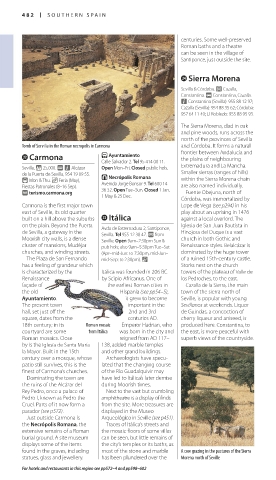
found in the graves, including most of the stone and marble A cow grazing in the pastures of the Sierra
statues, glass and jewellery. has been plundered over the Morena north of Seville
For hotels and restaurants in this region see pp572–4 and pp598–602
482-483_EW_Spain.indd 482 26/09/17 11:56 am

