


Page 552 - (DK Eyewitness) Travel Guide - Spain
P. 552
550 SP AIN ’ S ISLANDS
Fuerteventura
Lying just 100 km (60 miles) off the Atlantic coast of
Morocco, leaf-shaped Fuerteventura is continually battered
by coastal winds – no doubt why every summer the island
hosts the Windsurfing & Kiteboarding World Cup. It is the
second largest of the Canary Islands after Tenerife, and
the most sparsely populated: its 69,500 inhabitants are
outnumbered by goats. The island used to be densely
wooded, but European settlers cut down the timber for ship-
building; the dry climate (so dry, water has to be shipped
over from the mainland) and the goats have since reduced
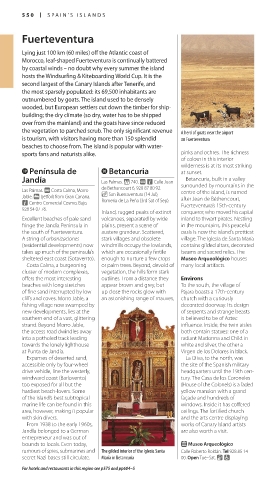
the vegetation to parched scrub. The only significant revenue A herd of goats near the airport
is tourism, with visitors having more than 150 splendid on Fuerteventura
beaches to choose from. The island is popular with water-
sports fans and naturists alike. pinks and ochres. The richness
of colour in this interior
wilderness is at its most striking
o Península de p Betancuria at sunset.
Jandía Las Palmas. * 740. @ n Calle Juan Betancuria, built in a valley
Las Palmas. @ Costa Calma, Morro de Bethancourt 6, 928 87 80 92. surrounded by mountains in the
centre of the island, is named
Jable. g (jetfoil) from Gran Canaria. _ San Buenaventura (14 Jul), after Jean de Béthen court,
n Centro Comercial Cosmo, Bajo, Romería de La Peña (3rd Sat of Sep). Fuerteventura’s 15th-century
928 54 07 76.
Inland, rugged peaks of extinct conqueror, who moved his capital
Excellent beaches of pale sand volcanoes, separated by wide inland to thwart pirates. Nestling
fringe the Jandía Peninsula in plains, present a scene of in the moun tains, this peaceful
the south of Fuerteventura. austere grandeur. Scattered, oasis is now the island’s prettiest
A string of urbanizaciones stark villages and obsolete village. The Iglesia de Santa María
(residential developments) now windmills occupy the lowlands, contains gilded altars, decorated
takes up much of the peninsula’s which are occa sionally fertile beams and sacred relics. The
shel tered east coast (Sotavento). enough to nurture a few crops Museo Arqueológico houses
Costa Calma, a burgeoning or palm trees. Beyond, devoid of many local artifacts.
cluster of modern complexes, vegetation, the hills form stark
offers the most interesting outlines. From a distance they Environs
beaches with long stretches appear brown and grey, but To the south, the village of
of fine sand interrupted by low up close the rocks glow with Pájara boasts a 17th-century
cliffs and coves. Morro Jable, a an astonishing range of mauves, church with a curiously
fishing village now swamped by decorated doorway. Its design
new developments, lies at the of serpents and strange beasts
southern end of a vast, glittering is believed to be of Aztec
strand. Beyond Morro Jable, in fluence. Inside, the twin aisles
the access road dwindles away both contain statues: one of a
into a potholed track leading radiant Madonna and Child in
towards the lonely lighthouse white and silver, the other a
at Punta de Jandía. Virgen de los Dolores in black.
Expanses of deserted sand, La Oliva, to the north, was
accessible only by four-wheel the site of the Spanish military
drive vehicle, line the westerly, headquarters until the 19th cen-
windward coast (Barlovento) – tury. The Casa de los Coroneles
too exposed for all but the (House of the Colonels) is a faded
hardiest beach-lovers. Some yellow mansion with a grand
of the island’s best subtropical façade and hundreds of
marine life can be found in this windows. Inside it has coffered
area, however, making it popular ceilings. The fortified church
with skin divers. and the arts centre displaying
From 1938 to the early 1960s, works of Canary Island artists
Jandía belonged to a German are also worth a visit.
entrepreneur and was out of
bounds to locals. Even today, E Museo Arqueológico
rumours of spies, submarines and The gilded interior of the Iglesia Santa Calle Roberto Roldán. Tel 928 85 14
secret Nazi bases still circulate. María in Betancuria 00. Open Tue–Sat. & 7
For hotels and restaurants in this region see p575 and pp604–5
550-551_EW_Spain.indd 550 26/09/17 11:03 am
Eyewitness Travel LAYERS PRINTED:
Catalogue template “UK” LAYER
(Source v2.1)
Date 5th December 2012
Size 125mm x 217mm

