


Page 553 - (DK Eyewitness) Travel Guide - Spain
P. 553
THE C ANAR Y ISLANDS 551
a Caleta de Fuste
Las Palmas. * 1,600. @ n Calle
Juan Ramón Soto Morales 10,
El Castillo, 928 16 32 86. ( Sat.
_ Día del Carmen (16 Jul), Nuestra
Señora de Antigua (8 Sep).
South of Puerto del Rosario
about halfway down the
eastern coast, lies Caleta de
Fuste. The attractive low-rise,
self-catering holiday centres
surround a horseshoe bay of
soft, gently shelving sand. The
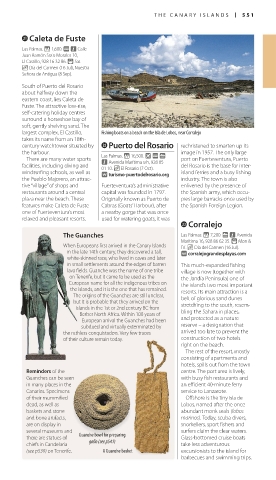
largest complex, El Castillo, Fishing boats on a beach on the Isla de Lobos, near Corralejo
takes its name from an 18th-
century watchtower situated by s Puerto del Rosario rechristened to smarten up its
the harbour. Las Palmas. * 16,500. k @ g image in 1957. The only large
There are many water-sports n Avenida Marítima s/n, 928 85 port on Fuerteventura, Puerto
facilities, including diving and 01 10. _ El Rosario (7 Oct). del Rosario is the base for inter-
windsurfing schools, as well as ∑ turismo-puertodelrosario.org island ferries and a busy fishing
the Pueblo Majorero, an attrac- industry. The town is also
tive “village” of shops and Fuerteventura’s administrative enlivened by the presence of
restaurants around a central capital was founded in 1797. the Spanish army, which occu-
plaza near the beach. These Originally known as Puerto de pies large barracks once used by
features make Caleta de Fuste Cabras (Goats’ Harbour), after the Spanish Foreign Legion.
one of Fuerteventura’s most a nearby gorge that was once
relaxed and pleasant resorts. used for watering goats, it was
d Corralejo
The Guanches Las Palmas. * 7,200. g n Avenida
Marítima 16, 928 86 62 35. ( Mon &
When Europeans first arrived in the Canary Islands Fri. _ Día del Carmen (16 Jul).
in the late 14th century, they discovered a tall, ∑ corralejograndesplayas.com
white-skinned race, who lived in caves and later
in small settlements around the edges of barren This much-expanded fishing
lava fields. Guanche was the name of one tribe village is now (together with
on Tenerife, but it came to be used as the the Jandía Peninsula) one of
European name for all the indigenous tribes on the island’s two most impor tant
the islands, and it is the one that has remained. resorts. Its main attraction is a
The origins of the Guanches are still unclear, belt of glorious sand dunes
but it is probable that they arrived on the stretching to the south, resem-
islands in the 1st or 2nd century BC from
Berber North Africa. Within 100 years of bling the Sahara in places,
European arrival the Guanches had been and protected as a nature
subdued and virtually exterminated by reserve – a designation that
the ruthless conquistadors. Very few traces arrived too late to prevent the
of their culture remain today. construction of two hotels
right on the beach.
The rest of the resort, mostly
consisting of apartments and
hotels, spills out from the town
Reminders of the centre. The port area is lively,
Guanches can be seen with busy fish restaurants and
in many places in the an efficient 40-minute ferry
Canaries. Specimens service to Lanzarote.
of their mummified Offshore is the tiny Isla de
dead, as well as Lobos, named after the once
baskets and stone abundant monk seals (lobos
and bone artifacts, marinos). Today, scuba divers,
are on display in snorkellers, sport fishers and
several museums and Guanche bowl for pre paring surfers claim the clear waters.
there are statues of Glass-bottomed cruise boats
chiefs in Candelaria gofio (see p541) take less adventurous
(see p539) on Tenerife. A Guanche basket excursionists to the island for
barbecues and swimming trips.
550-551_EW_Spain.indd 551 10/11/2017 09:48

