


Page 67 - (DK Eyewitness) Travel Guide - Spain
P. 67
THE HIST OR Y OF SP AIN 65
Seville School of Art
Seville’s wealth, together with the
patronage of the Church, made it a
centre of the arts, second only to the
royal court. Velázquez, who was born
in Seville, trained under the painter
Pacheco. Sculptor Juan Martínez
Montañés and painters Zurbarán and
Murillo created great works which are
displayed in the Museo de Bellas
Artes (see p436).
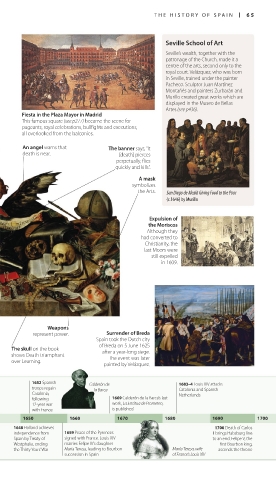
Fiesta in the Plaza Mayor in Madrid
This famous square (see p277) became the scene for
pageants, royal celebrations, bullfights and executions,
all overlooked from the balconies.
An angel warns that The banner says, “It
death is near. [death] pierces
perpetually, flies
quickly and kills”.
A mask
symbolizes
the Arts. San Diego de Alcalá Giving Food to the Poor
(c.1646) by Murillo
Expulsion of
the Moriscos
Although they
had converted to
Christianity, the
last Moors were
still ex pelled
in 1609.
Weapons
represent power. Surrender of Breda
Spain took the Dutch city
of Breda on 5 June 1625
The skull on the book after a year-long siege.
shows Death triumphant The event was later
over Learning.
painted by Velázquez.
1652 Spanish Calderón de 1683–4 Louis XIV attacks
troops regain la Barca Catalonia and Spanish
Catalonia, Netherlands
following 1669 Calderón de la Barca’s last
12-year war work, La Estátua de Prometeo,
with France is published
1640 1650 1660 1670 1680 1690 1700
1648 Holland achieves 1700 Death of Carlos
independence from 1659 Peace of the Pyrenees II brings Habsburg line
Spain by Treaty of signed with France. Louis XIV to an end. Felipe V, the
Westphalia, ending marries Felipe IV’s daughter first Bourbon king,
the Thirty Years’ War María Teresa, leading to Bourbon María Teresa, wife ascends the throne
succession in Spain of France’s Louis XIV
064-065_EW_Spain.indd 65 26/09/17 11:52 am

