


Page 86 - (DK Eyewitness) Travel Guide - Spain
P. 86
84 NOR THERN SP AIN
Forests of the North
Much of Spain was once blanketed by a mantle of
trees. Today, just ten per cent of the original cover
remains, mostly in the mountainous north, where
rainfall is high and slopes too steep for cultivation.
Large areas of mixed deciduous forest – mainly
beech, Pyrenean oak and chestnut, with some ash
and lime – dominate the landscape, particularly in
Cantabria and the Basque Country. The undergrowth
of shrubs and flowering plants provides habitats for
many insects, mammals and birds. The forests are
also the refuge of Spain’s last brown bears (see p108).
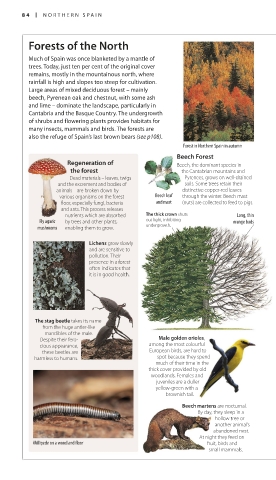
Forest in Northern Spain in autumn
Beech Forest
Regeneration of Beech, the dominant species in
the forest the Cantabrian mountains and
Dead materials – leaves, twigs Pyrenees, grows on well-drained
and the excrement and bodies of soils. Some trees retain their
animals – are broken down by distinctive copper-red leaves
various organisms on the forest Beech leaf through the winter. Beech mast
floor, especially fungi, bacteria and mast (nuts) are collected to feed to pigs.
and ants. This process releases
nutrients which are absorbed The thick crown shuts Long, thin
Fly agaric by trees and other plants, out light, inhibiting orange buds
mushrooms enabling them to grow. undergrowth.
Lichens grow slowly
and are sensitive to
pollution. Their
presence in a forest
often indicates that
it is in good health.
The stag beetle takes its name
from the huge antler-like
mandibles of the male.
Despite their fero- Male golden orioles,
cious appearance, among the most colourful
these beetles are European birds, are hard to
harmless to humans. spot because they spend
much of their time in the
thick cover provided by old
woodlands. Females and
juveniles are a duller
yellow-green with a
brownish tail.
Beech martens are nocturnal.
By day, they sleep in a
hollow tree or
another animal’s
abandoned nest.
At night they feed on
Millipede on a woodland floor fruit, birds and
small mammals.
084-085_EW_Spain.indd 84 26/09/17 11:53 am

