


Page 88 - (DK Eyewitness) Travel Guide - Spain
P. 88
86 NOR THERN SP AIN
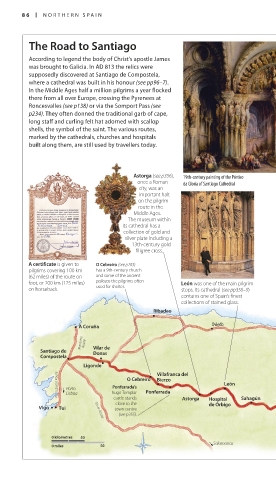
The Road to Santiago
According to legend the body of Christ’s apostle James
was brought to Galicia. In AD 813 the relics were
supposedly discovered at Santiago de Compostela,
where a cath edral was built in his honour (see pp96–7).
In the Middle Ages half a million pilgrims a year flocked
there from all over Europe, crossing the Pyrenees at
Roncesvalles (see p138) or via the Somport Pass (see
p234). They often donned the traditional garb of cape,
long staff and curling felt hat adorned with scallop
shells, the symbol of the saint. The various routes,
marked by the cathedrals, churches and hospitals
built along them, are still used by travellers today.
Astorga (see p356), 19th-century painting of the Pórtico
once a Roman da Gloria of Santiago Cathedral
city, was an
impor tant halt
on the pilgrim
route in the
Middle Ages.
The museum within
its cathedral has a
collection of gold and
silver plate including a
13th-century gold
filigree cross.
A certificate is given to O Cebreiro (see p103)
pilgrims covering 100 km has a 9th-century church
(62 miles) of the route on and some of the ancient
foot, or 200 km (125 miles) pallozas the pilgrims often León was one of the main pilgrim
used for shelter.
on horseback. stops. Its cathedral (see pp358–9)
contains one of Spain’s finest
collections of stained glass.
Ribadeo
•
A Coruña Oviedo
• •
Maritime Route
Santiago de Vilar de
Donas
Compostela
• •
Ligonde • Villafranca del
Portuguese Route Porto Ponferrada’s Ponferrada • • León
•
O Cebreiro
Bierzo
•
•
huge Templar
Lisboa
castle stands
close to the Astorga • Hospital Sahagún
•
de Órbigo
Vigo • • Tui Silver Route town centre
(see p355).
0 kilometres 50
Salamanca
0 miles 50
086-087_EW_Spain.indd 86 26/09/17 11:53 am

