


Page 89 - (DK Eyewitness) Travel Guide - Spain
P. 89
INTRODUCING NOR THERN SP AIN 87
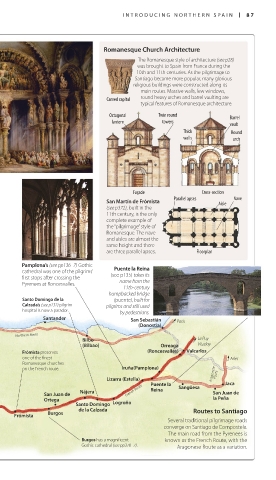
Romanesque Church Architecture
The Romanesque style of architecture (see p28)
was brought to Spain from France during the
10th and 11th centuries. As the pilgrimage to
Santiago became more popular, many glorious
religious buildings were constructed along its
main routes. Massive walls, few windows,
Carved capital round heavy arches and barrel vaulting are
typical features of Romanesque architecture.
Octagonal Twin round Barrel
lantern towers vault
Thick Round
walls arch
Façade Cross-section
San Martín de Frómista Parallel apses Aisle Nave
(see p372), built in the
11th century, is the only
complete example of
the “pilgrimage” style of
Romanesque. The nave
and aisles are almost the
same height and there
are three parallel apses. Floorplan
Pamplona’s (see pp136–7) Gothic
cathedral was one of the pilgrims’ Puente la Reina
first stops after crossing the (see p135) takes its
Pyrenees at Roncesvalles. name from the
11th-century
humpbacked bridge
Santo Domingo de la (puente), built for
Calzada’s (see p132) pilgrim pilgrims and still used
hospital is now a parador. by pedestrians.
Santander San Sebastián
• Paris
(Donostia)
•
Northern Route •
Bilbo Le Puy
(Bilbao) Orreaga Vézelay
Frómista preserves (Roncesvalles) • Valcarlos
one of the finest • Arles
Romanesque churches
on the French route. Iruña(Pamplona)
• Aragonese Route
Lizarra (Estella) • Puente la • • Jaca
•
•
Nájera French Route Reina Sangüesa San Juan de
San Juan de
Ortega • • • Logroño la Peña
• Santo Domingo
• de la Calzada
• Burgos Routes to Santiago
Frómista
Several traditional pilgrimage roads
converge on Santiago de Compostela.
The main road from the Pyrenees is
Burgos has a magnificent known as the French Route, with the
Gothic cathedral (see pp376–7). Aragonese Route as a variation.
086-087_EW_Spain.indd 87 26/09/17 11:53 am

