


Page 51 - All About History - Issue 70-18
P. 51
Scream Q


                                                    Ann                 Radcliffe (1764-1823)


                                                    A pioneer of Gothic’s first generation

                                                    Hailed as the “Great Enchantress” and        for the final two novels  published in
                                                    the “Shakespeare of Romance writers”,        her lifetime – £500  for The Mysteries Of
                                                    Ann Radcliffe was one of the most            Udolpho  and £800 for The  Italian, when
                                                    influential novelists of her era,  and made  £80 was the average. It is impossible to
                                                    a marked  impact  on the Gothic genre.       say what  more Radcliffe might
                                                       Especially acclaimed for The  Mysteries   have  achieved, had she  not
                                                    Of  Udolpho  (1794), Radcliffe became        largely stopped publishing aged 33,
                                                    known for a number    of innovations,        a decision thought to rest on her
                                                    particularly for her use of the ‘explained   sensitivity  to  criticism.
                                                    supernatural’ – her tales were concluded
                                                    with natural, yet complicated,
                                                    explanations. Some critics felt cheated by
                                                    this  device,  and Radcliffe dispensed with
                                                    it  in  her final (posthumously published)
                                                    novel Gaston de Blondeville  (1826),
                                                    instead crafting a real ghost.
                      “We    become                    But it has also been suggested
                 the   victims     of  our          that the ‘explained supernatural’ was

                  feelings    unless    we          authentically Gothic, delving into
                 can   in  some    degree           the fear of the supernatural rather
                                                    than supernatural beings themselves.
                   command        them”             Radcliffe’s works – which soaked  up  the
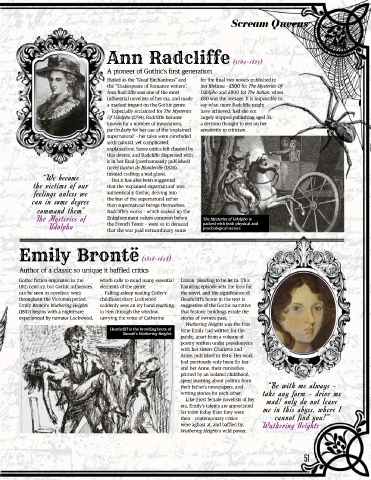
                  The    Mysteries      of          Enlightenment values   common before          The Mysteries of Udolpho is

                         Udolpho                    the French Terror – were so in demand         packed with both physical and
                                                                                                  psychological terrors
                                                    that  she was paid  extraordinary sums


          Emily Brontë (1818-1848)


          Author     of  a classic so unique       it  baffled critics

          Gothic fiction originated in the       which calls to  mind many  essential   Linton, pleading to be let in. This
          18th century, but Gothic influences    elements  of  the  genre.              haunting  episode sets  the tone for
          can be seen in novelists’ work           Falling asleep reading Cathy’s       the novel, and the significance  of
          throughout the Victorian period.       childhood diary Lockwood               Heathcliff’s home in the text is
          Emily  Brontë’s  Wuthering  Heights    suddenly sees an icy hand reaching     suggestive of the Gothic narrative
          (1847) begins with a nightmare         to him through the window,             that historic buildings exude the
          experienced by narrator Lockwood,      carrying the voice of Catherine        stories of  owners  past.
                                                                                          Wuthering  Heights  was the first
                                                      Heathcliff is the brooding brute of   time Emily had written for the
                                                            Brontë’s Wuthering Heights
                                                                                        public, apart from a volume of
                                                                                        poetry  written under pseudonyms
                                                                                        with her sisters Charlotte and
                                                                                        Anne, published  in  1846. Her work
                                                                                        had previously only been  for her
                                                                                        and her Anne, their curiosities
                                                                                        primed by an isolated childhood,
                                                                                        spent learning about politics from
                                                                                                                                   B
                                                                                                                                             h
                                                                                                                                  “Be with me always -
                                                                                        their father’s newspapers, and            “ B        h         l l
                                                                                        writing stories for each other.        take any form - drive             me
                                                                                          Like  most female novelists of  her    mad! only do not leave
                                                                                        era,  Emily’s talents are appreciated
                                                                                        far more today than  they were         me    in  this   abyss,    where     I
                                                                                        then  –  contemporary  critics               cannot     find   you!”
                                                                                        were aghast at, and baffled by,        Wuthering        Heights
                                                                                        Wuthering  Heights’s  wild  power.


                                                                                                                                                   51

