


Page 52 - All About History - Issue 70-18
P. 52
Gothic literature


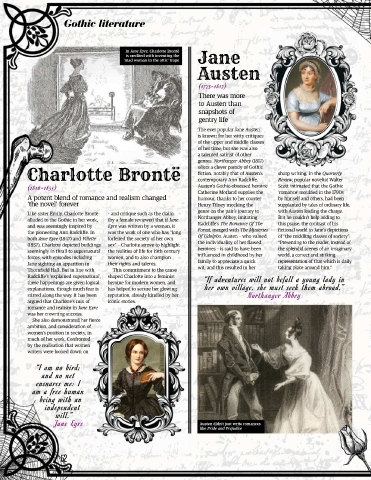
                                                             In Jane Eyre, Charlotte Brontë
                                                             is credited with inventing the     Jane
                                                            ‘mad woman in the attic’ trope

                                                                                                Austen


                                                                                                (1775-1817)

                                                                                                There was more
                                                                                                to  Austen    than
                                                                                                snapshots      of

                                                                                                gentry    life

                                                                                                The ever popular Jane Austen
                                                                                                is  known for her witty critiques
                                                                                                of the upper and middle classes
                                                                                                of her time, but she was also
                                                                                                a talented satirist of other
                                                                                                genres. Northanger Abbey  (1817)
                                                                                                offers
                                                                                                              parody of Gothic
                                                                                                      a clever
              Charlotte                                   Brontë                                fiction, notably that of Austen’s     sharp writing. In the Quarterly
                                                                                                contemporary Ann Radcliffe.
                                                                                                                                      Review, popular novelist Walter
              (1816-1855)                                                                       Austen’s  Gothic-obsessed heroine     Scott intimated that  the Gothic
                                                                                                Catherine Morland supplies  the       ‘romance’ moulded in  the 1790s
              A potent blend of romance and realism changed                                     humour, thanks   to  her courter      by himself and others, had been
              ‘the  novel’   forever                                                            Henry Tilney mocking the              supplanted by tales of ordinary life,
                                                                                                genre on the pair’s  journey to       with Austen leading the charge.
              Like sister Emily, Charlotte Brontë    – and critique such as the claim
              alluded to  the Gothic in  her work,   (by a female reviewer) that  if  Jane      Northanger Abbey, imitating           But he couldn’t help  adding to
              and was seemingly inspired by          Eyre  was written by a woman, it           Radcliffe’s The Romance Of The        this praise, the contrast of his
              the pioneering Ann Radcliffe. In       was the work  of one who has “long         Forest, merged with The  Mysteries    fictional world to  Jane’s depictions
                                                                                                                    –
              both Jane  Eyre  (1847) and Villette   forfeited the society of her own           Of  Udolpho. Austen who valued        of “the middling  classes of society”:
              (1857),  Charlotte  depicted  buildings  sex” Charlotte strove  to  highlight     the individuality of her flawed       “Presenting to the reader, instead of
                                                          –
              seemingly in thrall to supernatural    the realities of life for 19th  century    heroines – is said to have been       the splendid scenes of an imaginary
              forces, with episodes including        women, and to also champion                influenced in childhood by her        world, a correct and striking
              Jane sighting an apparition in         their rights and talents.                  family to appreciate a quick          representation of that which is daily
              Thornfield  Hall. But in  line with      This commitment to the cause             wit, and this resulted in her         taking place around him.”
              Radcliffe’s ‘explained supernatural’,   shaped Charlotte into a feminist
              these happenings are given logical     heroine for modern  women,  and               “If  adventures       will   not   befall   a  young     lady    in
              explanations, though much fear is      has helped  to  secure her glowing            her   own    village,     she  must     seek   them    abroad.”
              stirred along the way. It has been     reputation, already kindled by her                                 Northanger       Abbey
              argued that Charlotte’s mix of         iconic stories.
              romance and realism in  Jane  Eyre
              was her crowning   success.
                 She also  demonstrated her fierce
              ambition, and consideration of
              women’s position in society, in
              much   of her work. Confronted
              by the realisation that women
              writers  were  looked  down  on


                  “I  am    no   bird;
                     and    no   net

                   ensnares     me:    I
                 am   a  free   human
                    being    with    an

                       independent
                            will.”

                           Jane    Eyre                                                          Austen didn’t just write romances
                                                                                                 like Pride and Prejudice


                                2

