


Page 55 - All About History - Issue 70-18
P. 55
Sc


           This original 1778 illustration from
           the Old English Baron hints at the                                               Elizabeth
           tale’s murderous medieval goings-on


                                                                                            Gaskell (1810-1865)


                                                                                            Charlotte Brontë’s       biographer     dipped her
                                                                                            toes  into  Gothic    literature


                                                                                            Elizabeth Gaskell delved into         communication rather than drastic
                                                                                            all sorts of genres, from social      change. But she understood
                                                                                            commentary to Gothic. She had         well the two lives writer  women
                                                                                            Gothic tales printed in Harper’s      had to lead. Describing the
                                                                                            Magazine, with supernatural           publication of Jane Eyre, she wrote,
                                                                                            devices offering a means of           “Henceforward Charlotte   Brontë’s
                                                                                            examining themes such as              existence becomes divided   into
                                                                                            power, weakness, oppression           two parallel currents –  her life as
                                                                                            and redemption. Gaskell’s devout
                                                                                                                                  Currer Bell, the author; her life as
                                                      Clara                                 Unitarian faith instilled in her the  Charlotte Brontë, the woman.  There
                                                                                            social values which lay deep in the
                                                                                                                                                                  to
                                                                                                                                  were separate duties belonging
                                                      Reeve                                 pages of her books. Mary Barton: A    each character – not opposing each
                                                                                            Story of Manchester Life (1848) was
                                                                                                                                  other; not impossible, but difficult
                                                                                            acclaimed by Charles Kingsley in      to be reconciled.”
                                                      (1729-1807)                           Fraser’s Magazine for explaining
                                                      Created the ‘literary                 to the middle classes Chartism,
                                                                                            “Do they want to know why poor
                                                      offspring’    of                      men, kind and sympathising as
                                                      Walpole’s     Otranto                 women to each other, learn to hate

                                                                                            law and order, queen, lords and
                                                      Clara Reeve may not be as             commons, country-party and corn
                                                     well known as her more                 law leagues, all alike – to hate the
                                                     famous contemporaries,                 rich in short? Then let them read
                                                     but she made an intriguing             Mary Barton.”
                                                    contribution to Gothic fiction            Gaskell was neither a radical
                                                   with The Old English Baron (1778),       nor impassioned feminist; she
                                                  inspired by Horace Walpole’s The          spoke of understanding and
                                                Castle Of Otranto (often thought of
                                              as the first Gothic novel). The book’s
                                           preface describes it as “the literary            “‘Such    whispered      tales,
                                      offspring” of Otranto, likewise designed to
                           “unite the most attractive and interesting circumstances         such   old   temptations
          of the ancient romance and modern novel”. The model proved popular –              and   hauntings,       and
          an eighth edition materialised in 1807, and there were many additional            devilish    terrors’”
          reprints throughout the century. Reeve grew up reading classical works            Lois   the   Witch
          on republicanism and when the French Revolution came, she welcomed
          the development, and made a call for change, “The revolution in France
          will be a standing lesson to princes and to people of all countries; it is a
          warning to  kings, how they oppress and impoverish their people; it warns
          them  to  reform the errors  and corruptions of their governments, and to
          prevent the necessity of a revolution.” This text foresaw an important role
          for women, invoking a theme of works including Mary Wollstonecraft’s
          Vindication Of  The Rights  Of Woman. Although Reeve’s thinking here
          was more conservative, encouraging discipline, order, and hierarchy as in
          counter-revolutionary  works by women.
                                              “‘Though      I  have   been    dead
                                               these    fifteen   years,    I  still

                                          command       here,    and    none    can
                                                enter   these    gates   without
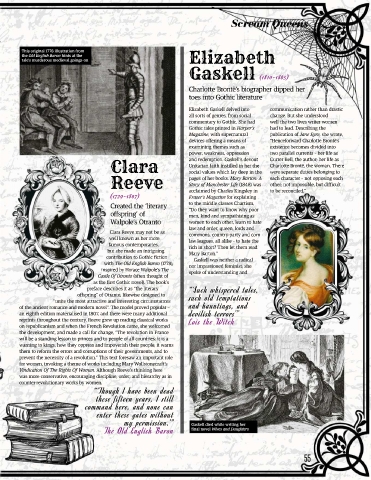
                                                             my   permission.’”              Gaskell died while writing her

                                                   The   Old    English     Baron            final novel Wives and Daughters


                                                                                                                                                   55

