


Page 54 - All About History - Issue 70-18
P. 54
Gothic literature


              Charlotte                                   Perkins                             Gilman (1860-1935)


              A  multifaceted      American       writer   and   feminist    icon

              Gilman’s haunting novella The  Yellow  Wallpaper  (1892),   She suffered  from postpartum  depression following
              about a woman confined to   her bedroom,  draws on        the birth of her daughter  Katharine, and underwent
              her own experience   of mental  illness.                  the controversial ‘rest cure’, which prohibited
                                                                        intellectual  stimulation and most exercise. Her tale
                                                                        features  Gothic themes  to  explore the protagonist’s
                                                                        heightening distress. The room’s  sense of a prison –
                                                                        including barred  windows – links to  the motif of the
                                                                        insane asylum, and Gilman’s   language is  ambiguous
                                                                        as  to  whether the events  are grounded in  reality or
                                                                        the supernatural. The movements of the “repellent”
                                                                        wallpaper as  seen  by the woman synchronise with
                                                                        her deterioration. Gothic ideas are also evident in the
                                                                        novella’s ending. Consciously reversing the Gothic
                                                                        scene of a heroine fainting  out of terror, Gilman  has
                                                                        her protagonist’s husband faint upon seeing  his wife.
                                                                          Today Gilman is celebrated as a feminist icon – she
                                                                        divorced her husband (sending their daughter to
                                                                        live with him and his second wife), entered into a
                                                                        happy marriage with her first cousin, and dedicated         “There    are   things    in   that
                                                                        herself to the women’s suffrage campaign. The Yellow        paper    that   nobody      knows
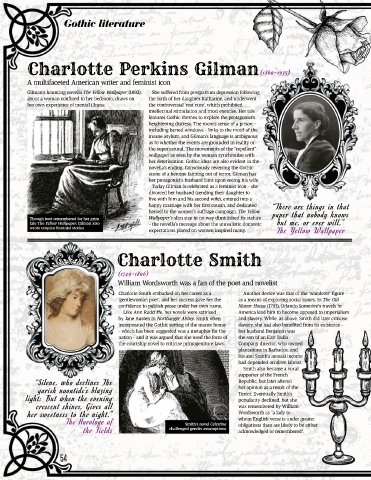
               Though best remembered for her grim                      Wallpaper’s slim size in no way diminished its stature
               tale The Yellow Wallpaper, Gilman also                   – the novella’s message about the unrealistic domestic        but   me,    or  ever   will.”
               wrote utopian feminist stories
                                                                        expectations placed on women inspired many.                   The   Yellow      Wallpaper


                                                         Charlotte Smith


                                                          (1749-1806)

                                                          William Wordsworth was a fan of the poet and novelist

                                                          Charlotte Smith embarked   on her career  as  a             Another device was that  of the ‘wanderer’  figure
                                                          ‘gentlewoman   poet’,  and her success gave  her the     as a means of exploring social issues. In The  Old
                                                          confidence to  publish prose under her own name.         Manor House   (1793), Orlando Somerive’s travels in
                                                            Like  Ann Radcliffe, her novels  were satirised        America lead him to  become opposed to   imperialism
                                                          by Jane Austen in Northanger Abbey. Smith often          and slavery.  While, as  above, Smith did later criticise
                                                          incorporated the Gothic setting of the manor house       slavery,  she had also  benefited from its existence –
                                                          – which has been  suggested was a metaphor for the       her husband Benjamin was
                                                          nation – and it  was argued  that  she used  the form  of  the son of an East India
                                                          the courtship novel to  criticise primogeniture laws.    Company director, who owned
                                                                                                                   plantations in Barbados, and
                                                                                                                   his and Smith’s annual  income
                                                                                                                   had depended on slave labour.
                                                                                                                      Smith also  became a vocal
                                                                                                                   supporter of the French
                  “Silene,     who    declines    The                                                              Republic,  but  later  altered

                    garish    noontide’s     blazing                                                               her opinion as  a result  of the
                                                                                                                                      Smith’s
                                                                                                                           Eventually
                                                                                                                   Terror.
              light;   But    when     the   evening                                                               popularity declined, but she
                   crescent    shines,    Gives    all                                                             was remembered by William
              her   sweetness      to  the   night.”                                                               Wordsworth as “a lady to
                                 The   Horologe      of                                   Smith’s novel Celestina   whom English verse is under greater
                                                                                                                   obligations than are likely to be either
                                         the   Fields                             challenged gender assumptions    acknowledged   or remembered”.


                              54

