


Page 68 - All About History - Issue 70-18
P. 68
Medieval murders


                                                                                                            dismembered them. He preferred male victims and revelled
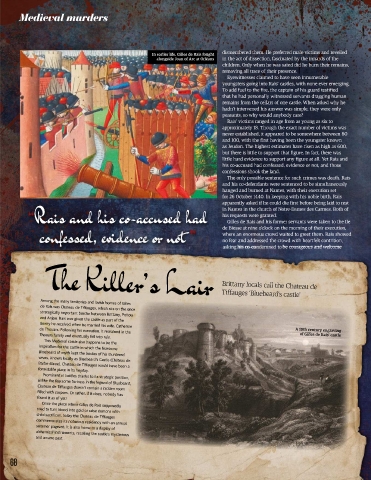
                                                                          In earlier life, Gilles de Rais fought
                                                                            alongside Joan of Arc at Orléans  in the act of dissection, fascinated by the innards of the
                                                                                                            children. Only when he was sated did he burn their remains,
                                                                                                            removing all trace of their presence.
                                                                                                              Eyewitnesses claimed to have seen innumerable
                                                                                                            youngsters going into Rais’ castles, with none ever emerging.
                                                                                                            To add fuel to the fire, the captain of his guard testified
                                                                                                            that he had personally witnessed servants dragging human
                                                                                                            remains from the cellars of one castle. When asked why he
                                                                                                            hadn’t intervened his answer was simple, they were only
                                                                                                            peasants, so why would anybody care?
                                                                                                              Rais’ victims ranged in age from as young as six to
                                                                                                            approximately 18. Though the exact number of victims was
                                                                                                            never established, it appeared to be somewhere between 80
                                                                                                            and 100, with the first having been the youngster known
                                                                                                            as Jeudon. The highest estimates have risen as high as 600,
                                                                                                            but there is little to support that figure. In fact, there was
                                                                                                            little hard evidence to support any figure at all. Yet Rais and
                                                                                                            his co-accused had confessed, evidence or not, and those
                                                                                                            confessions shook the land.
                                                                                                              The only possible sentence for such crimes was death. Rais
                                                                                                            and his co-defendants were sentenced to be simultaneously
                                                                                                            hanged and burned at Nantes, with their execution set
                                                                                                            for 26 October 1440. In keeping with his noble birth, Rais
                                                                                                            apparently asked if he could die first before being laid to rest
              “Rais and his co-accused had                                                                  in Nantes in the church of Notre-Dames des Carmes. Both of

                                                                                                            his requests were granted.
                                                                                                              Gilles de Rais and his former servants were taken to the Ile
                                                                                                            de Biesse at nine o’clock on the morning of their execution,
                                                                                                            where an enormous crowd waited to greet them. Rais showed
                                                                                                            no fear and addressed the crowd with heartfelt contrition,
                                                                                                                   his co co             be courageous and welcome


                       The Killer’s Lair


                                                                                                           Brittany locals call the Chateau de
                                                                                                           Tiffauges ‘Bluebeard’s castle’

                     Among the many territories and lavish homes of Gilles
                    de Rais was Chateau de Tiffauges, which sits on the once
                    strategically important border between Brittany, Poitou
                    and Anjou. Rais was given the castle as part of the
                    dowry he received when he married his wife, Catherine
                                                                                                                                               A 19th century engraving
                    de Thouars. Following his execution, it remained in the
                                                                                                                                                 of Gilles de Rais’ castle
                    Thouars family and eventually fell into ruin.
                      This Medieval castle also happens to be the
                    inspiration for the castle in which the fearsome
                    Bluebeard of myth kept the bodies of his murdered
                    wives. Known locally as Bluebeard’s Castle (Château de
                   Barbe-Bleue), Chateau de Tiffauges would have been a
                   formidable place in its heyday.
                      Prominent in battles thanks to its strategic position,
                   unlike the fearsome fortress in the legend of Bluebeard,
                   Chateau de Tiffauges doesn’t contain a hidden room
                   filled with corpses. Or rather, if it does, nobody has
                   found it as of yet!

                     Once the place where Gilles de Rais supposedly
                   tried to turn blood into gold or raise demons with
                   child sacrifices, today the Chateau de Tiffauges
                   commemorates its notorious residency with an annual
                  summer pageant. It is also home to a display of
                  alchemical instruments, recalling the castle’s mysterious
                  and arcane past.


      68

