


Page 70 - All About History - Issue 70-18
P. 70
Neil Armstrong


          “     One                                                 small


          step                                                   for                                   man…
                                                                                                                                                                    ”


                            Inside        the personal journey of                         Neil     Armstrong,


                                  from flying ace to first man on the Moon


                                                           Written by Dr Gemma Lavender


         N            eil Armstrong was going down. Long before Apollo     flying ace Chuck Yeager first broke the sound barrier in 1947,
                                                                           and the cutting-edge in aeronautics were developed. However,
                      11 entered the history books, Armstrong was a
                                                                           a test pilot’s life was never easy. On 22 March 1956, Armstrong
                      US
                         Navy
                              fighter pilot, serving in the Korean War.
                                                                           was tasked
                      Just
                                                       officer in the
                                                                                      with flying a modified B-29 Superfortress, which was
                          21 years old, he
                                          was youngest
                                                                his
                      VF-51 Screaming Eagles all-jet squadron. On
                                                                           feet, one of the B-29’s four engines stopped
                                                                                                                      working.
          first mission, his Grumman F9F-2B  Panther was strafed by anti-  to deploy a smaller Skyrocket plane in midair. But at 30,000
          aircraft fire as  he  carried out a low-altitude  bombing at 350 mph  To  maintain an airspeed suitable  for deploying the Skyrocket,
          (560 km/h).  As  he  struggled to get his plane under control, his  Armstrong and his co-pilot Stan Butchart had to enter a dive.
          right wing clipped a pole  just  metres above the ground, ripping  As  the Skyrocket successfully blasted off,  one of the blades
          part  of it clean off.  Showing the nerves  of steel that would  from the broken  engine’s  propellor flew off and took  out two of
          define  his illustrious career, Armstrong somehow managed to fly  the B-29’s other  engines.  Armstrong still managed to land the
          his wrecked jet back to safe territory before ejecting.          33,800 kg  bomber  with just  the one remaining engine.
             Born on 5 August 1930, in the small town of Wapakoneta,         Armstrong was involved in numerous other  dangerous
          Ohio, Armstrong fell in love  with airplanes at a young age. He  incidents.  One of his fellow test  pilots, William J ‘Pete’
          took  his first flight with his father, Stephen, at the age of six,  Knight, who came  up through the Air Force, attributed  this to
          before getting his pilot’s licence as  a teen. However, aeronautical  ‘pilot-engineers’ such  as  Armstrong tending to fly in a more
          engineering was his real passion – understanding how planes      mechanical and less  instinctive fashion. However, others thought
          fly,  and how to make them  fly better. He  studied at Purdue    Armstrong’s ability to survive these disasters proved he  was one
          University in Indiana, before being called up to the US Navy.    of the best test pilots in the business.
                                                                                             –
                                                                                                                     –
             Three years,  78 combat missions, 121 hours in the air and five  Certainly NASA as  it was called  by 1958 thought so. But
          medals later, Armstrong retired from active service, completed   they still had a requirement that you had to be a military test
          his university degree, and began a new career  as  a test  flight  pilot to become  a NASA  astronaut. Since  he  had left  the navy,
          pilot.  Armstrong was sent to the famous Edwards Air Force Base  Armstrong was now a civilian. He  was therefore ineligible  to
          in California. Home to the High-Speed Flight Station, this was   be  part  of the ‘Mercury 7’  team, which headed  up the United
          operated by the National Advisory Committee for Aeronautics      State’s first space mission. However, in 1962, everything
          (NACA), the precursor to NASA. This  desert base  was where      changed for Armstrong, for better  and for worse.
                                                                                                        Armstrong had married  his first
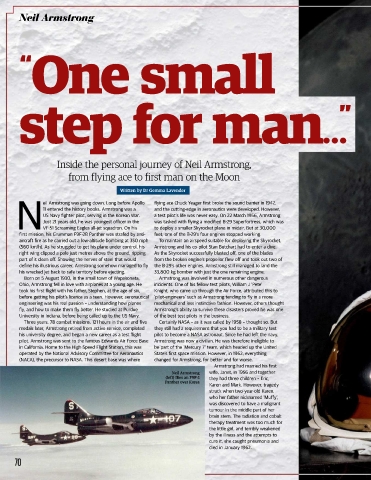
                                                                                   Neil Armstrong    wife, Janet, in 1956 and together
                                                                                (left) flies an F9F-2   they had three children – Eric,
                                                                                Panther over Korea
                                                                                                     Karen and Mark. However, tragedy
                                                                                                     struck  when  two-year-old  Karen,
                                                                                                     who her father  nicknamed  ‘Muffy’,
                                                                                                     was discovered  to have  a malignant
                                                                                                     tumour in the middle part of her
                                                                                                     brain stem. The radiation and cobalt
                                                                                                     therapy treatment was too much   for
                                                                                                     the little girl, and terribly  weakened
                                                                                                     by the illness and the attempts to
                                                                                                     cure it, she caught pneumonia and
                                                                                                     died in January 1962.


        70

