


Page 72 - All About History - Issue 70-18
P. 72
Neil Armstrong


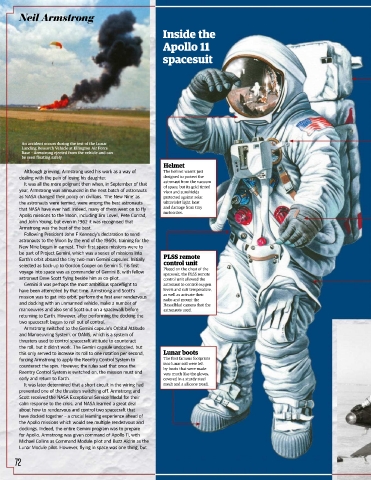
                                                                               Inside           the


                                                                               Apollo            11

                                                                               spacesuit


           An accident occurs during the test of the Lunar
           Landing Research Vehicle at Ellington Air Force
           Base – Armstrong ejected from the vehicle and can
           be seen floating safely

                                                                               Helmet
             Although  grieving, Armstrong used  his work as  a way of         The helmet wasn’t just
          dealing with the pain of losing his daughter.                        designed to protect the
             It was all the more poignant then  when, in September of that     astronaut from the vacuum
                                                                               of space, but its gold tinted
          year, Armstrong was announced in the next  batch of astronauts       visor and sunshields
          as  NASA  changed their policy  on  civilians.  ‘The  New Nine’ as   protected against solar
          the astronauts were termed, were among the best  astronauts          ultraviolet light, heat
          that NASA have ever had. Indeed, many of them went on to fly         and damage from tiny
          Apollo  missions  to the Moon, including Jim Lovell, Pete Conrad,    meteorites.
          and John Young, but even in 1962 it was recognised that
          Armstrong was the best of the best.
             Following President John F Kennedy’s declaration to send
          astronauts to the Moon  by the end of the 1960s,  training for the
          New Nine began in earnest.  Their first space missions  were to
          be  part  of Project Gemini, which was a series  of missions  into
          Earth’s orbit aboard the tiny two-man Gemini capsules. Initially     PLSS remote
          selected as back-up to Gordon Cooper on Gemini 5, his first          control unit
          voyage into space was as  commander of Gemini 8, with fellow         Placed on the chest of the
                                                                               spacesuit, the PLSS remote
          astronaut Dave  Scott flying beside  him as  co-pilot.               control unit allowed the
             Gemini 8 was perhaps the most  ambitious spaceflight to           astronaut to control oxygen
          have been attempted by that time. Armstrong and Scott’s              levels and suit temperature,
          mission was to get into orbit, perform the first ever  rendezvous    as well as activate their
                                                                               radio and mount the
          and docking with an unmanned vehicle, make a number    of            Hasselblad camera that the
          manoeuvres   and also  send  Scott out on  a spacewalk before        astronauts used.
          returning to Earth. However, after performing the docking the
          two spacecraft began to roll out of control.
             Armstrong switched to the Gemini capsule’s Orbital Attitude
          and Manoeuvring System, or  OAMS, which is  a system  of
          thrusters used  to control spacecraft attitude  to counteract
          the roll, but it didn’t  work. The Gemini capsule undocked, but
          this only served to increase its roll to one rotation per second,    Lunar boots
          forcing Armstrong to apply the Reentry Control System to             The first famous footprints
          counteract  the spin. However, the rules said that once  the         into lunar soil were left
                                                                               by boots that were made
          Reentry Control System  is  switched on, the mission must  end       very much like the gloves,
          early and return to Earth.                                           covered in a sturdy steel
             It was later determined  that a short circuit in the wiring had   mesh and a silicone tread.
          prevented one of the thrusters switching off.  Armstrong and
          Scott received  the NASA  Exceptional Service Medal for their
          calm response  to the crisis, and NASA  learned a great deal
          about how to rendezvous   and control two spacecraft that
          have  docked  together a crucial learning experience ahead of
                                –
          the Apollo  missions  which would see multiple  rendezvous  and
          dockings. Indeed, the entire Gemini program was to prepare
          for Apollo. Armstrong was given command of Apollo  11, with
          Michael Collins as  Command Module  pilot and Buzz  Aldrin as  the
          Lunar Module  pilot.  However, flying in space was one thing, but


        72

