


Page 69 - All About History - Issue 70-18
P. 69
The Baron of Blood


                                                                                                            potential misfortune to  have  been  accused at  a time when
                                                                                                            the pitchforks were out. Some of those who have made a
                                                                                                            case  for his acquittal more recently, including the notorious
                                                                                                            occultist Aleister Crowley, have claimed that Rais might well
                                                                                                            have  practised witchcraft  or paganism but was not involved
                                                                                                            in any criminal activity. Instead, the argument follows, he
                                                                                                            was simply a martyr to ancient religion, a victim of the
                                                                                                            Inquisition that  swept across  the continent.
                                                                                                              According to some sources, in 1992, Jean-Yves Goëau-
                                                                                                            Brissonnière, Freemason Grand Master of the Grand Lodge
                                                                                                            of France, organised a so-called retrial of Rais  before a court
                                                                                                            of politicians and UNESCO experts.  It  returned a verdict of
                                                                                                            not guilty. Critics of the trial have  pointed out that  no one
                                                                                                            involved in the endeavour was a Medieval historian and it did
                                                                                                            little to  sway  those who believed  Rais  was guilty.
                                                                                                              The grisly story of Gilles  de Rais  has persisted in  the public
                                                                                                            consciousness, serving as one inspiration amongst many for
                                                                                                            the legend of Bluebeard,  the most famous surviving version
                                                                                                            of which was written by Charles Perrault  in  1697. The story
                                                                                                            of Bluebeard is  that  of a fearsome yet immensely wealthy
                                                                                                            nobleman whose wives have a nasty habit of disappearing.
                                                                                                            He  is  later found to  have  murdered  them  and stored their
                                                                                                            bodies  in  a locked  room, which is  discovered  by his newest
                                                                                                            bride thanks to a magical key. Of course, Bluebeard is
                                                                                                            eventually vanquished and the forces  of good  prevail.
                                                                                                              No human remains were found in     Rais’ property  and his
                                                                                                            victims were children. Therefore, his role in  the story of
                                                                                                            Bluebeard is  a somewhat  generic one, that  of a wealthy and
                                                                                                            well-connected  pillar  of the establishment who is  secretly a
                                                                                                            monster. Another Brittany-based inspiration can be found in

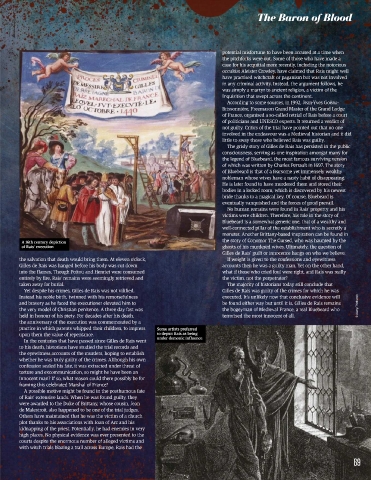
           A 16th century depiction                                                                         the story of Conomor The Cursed, who was haunted by the
           of Rais’ execution                                                                               ghosts  of his murdered  wives.  Ultimately, the question of
                                                                                                            Gilles  de Rais’ guilt or innocence hangs  on who we  believe.
          the salvation that death would bring them. At eleven  o’clock,                                      If weight is given to the confessions and eyewitness
          Gilles  de Rais  was hanged  before his body was cut down                                         accounts then  he was a guilty  man.  Yet on the other hand,
          into the flames. Though Poitou and Henriet were consumed                                          what  if  those who cried foul  were right, and Rais  was really
          entirely by fire, Rais’ remains were seemingly retrieved and                                      the victim, not the perpetrator?
          taken  away  for  burial.                                                                           The majority of historians today still conclude that
             Yet despite his crimes, Gilles  de Rais  was not vilified.                                     Gilles de Rais was guilty of the crimes for which he was
          Instead his noble birth,  twinned with  his remorsefulness                                        executed. It’s unlikely now that conclusive evidence will
          and bravery as he faced the executioner elevated him to                                           be found either way but until it is, Gilles de Rais remains      © Alamy, Thinkstock
          the very  model of Christian penitence. A three day fast was                                      the bogeyman of Medieval France, a real Bluebeard who
          held  in  honour of his piety.  For decades after his death,                                      terrorised the most innocent of all.
          the anniversary of the execution was commemorated by a
          practice  in  which parents whipped their children, to  impress   Some artists preferred
          upon them the value of repentance.                                to depict Rais as being
             In the centuries that have passed since Gilles de Rais went    under demonic influence
          to his death, historians have studied the trial records and
          the eyewitness  accounts of the murders,  hoping  to  establish
          whether he was truly guilty  of the crimes. Although his own
          confession sealed his fate, it was extracted under threat of
          torture and excommunication, so   might he have  been  an
          innocent man? If so, what reason could there possibly be for
          framing this celebrated Marshal of France?
             A possible motive might be found in the posthumous fate
          of Rais’ extensive lands.  When  he was found guilty, they
          were awarded to the Duke of Brittany, whose cousin, Jean
          de Malestroit, also  happened  to  be  one of the trial judges.
          Others have maintained that he was the victim of a church
          plot thanks to his associations with Joan of Arc and his
          kidnapping  of the priest. Potentially,  he had enemies in  very
          high  places. No physical  evidence  was ever  presented to  the
          courts despite the enormous number of alleged victims and
          with  witch trials  blazing a trail across  Europe, Rais  had the


                                                                                                                                                                           69

