


Page 106 - (DK) Smithsinian - Military History: The Definitive Visual Guide to the Objects of Warfare
P. 106
104    EPIC FORTIFICATION

         WMEN 500–1500  THE GREAT


            WALL OF CHINA


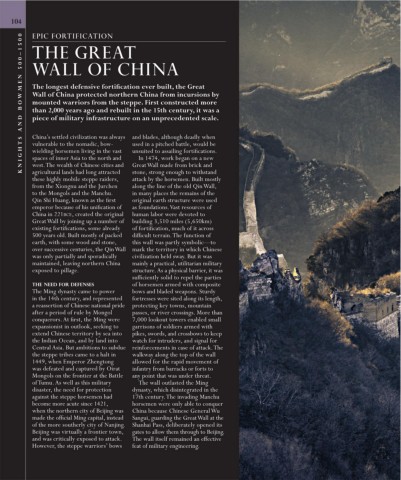
            The longest defensive fortification ever built, the Great


            mounted warriors from the steppe. First constructed more
         AND BO  Wall of China protected northern China from incursions by
            than 2,000 years ago and rebuilt in the 15th century, it was a
            piece of military infrastructure on an unprecedented scale.


         KNIGHTS   China’s settled civilization was always  and blades, although deadly when
                                                used in a pitched battle, would be
            vulnerable to the nomadic, bow-
            wielding horsemen living in the vast
                                                unsuited to assailing fortifications.
                                                  In 1474, work began on a new
            spaces of inner Asia to the north and
            west. The wealth of Chinese cities and
                                                Great Wall made from brick and
            agricultural lands had long attracted
                                                attack by the horsemen. Built mostly
            these highly mobile steppe raiders,   stone, strong enough to withstand
            from the Xiongnu and the Jurchen    along the line of the old Qin Wall,
            to the Mongols and the Manchu.      in many places the remains of the
            Qin Shi Huang, known as the first   original earth structure were used
            emperor because of his unification of   as foundations. Vast resources of
            China in 221BCE, created the original   human labor were devoted to
            Great Wall by joining up a number of  building 3,510 miles (5,650km)
            existing fortifications, some already   of fortification, much of it across
            500 years old. Built mostly of packed   difficult terrain. The function of
            earth, with some wood and stone,    this wall was partly symbolic—to
            over successive centuries, the Qin Wall  mark the territory in which Chinese
            was only partially and sporadically   civilization held sway. But it was
            maintained, leaving northern China   mainly a practical, utilitarian military
            exposed to pillage.                 structure. As a physical barrier, it was
                                                sufficiently solid to repel the parties
            THE NEED FOR DEFENSES               of horsemen armed with composite
            The Ming dynasty came to power      bows and bladed weapons. Sturdy
            in the 14th century, and represented   fortresses were sited along its length,
            a reassertion of Chinese national pride  protecting key towns, mountain
            after a period of rule by Mongol    passes, or river crossings. More than
            conquerors. At first, the Ming were   7,000 lookout towers enabled small
            expansionist in outlook, seeking to   garrisons of soldiers armed with
            extend Chinese territory by sea into   pikes, swords, and crossbows to keep
            the Indian Ocean, and by land into   watch for intruders, and signal for
            Central Asia. But ambitions to subdue  reinforcements in case of attack. The
            the steppe tribes came to a halt in   walkway along the top of the wall
            1449, when Emperor Zhengtong        allowed for the rapid movement of
            was defeated and captured by Oirat   infantry from barracks or forts to
            Mongols on the frontier at the Battle   any point that was under threat.
            of Tumu. As well as this military     The wall outlasted the Ming
            disaster, the need for protection   dynasty, which disintegrated in the
            against the steppe horsemen had     17th century. The invading Manchu
            become more acute since 1421,       horsemen were only able to conquer
            when the northern city of Beijing was   China because Chinese General Wu
            made the official Ming capital, instead   Sangui, guarding the Great Wall at the
            of the more southerly city of Nanjing.  Shanhai Pass, deliberately opened its
            Beijing was virtually a frontier town,   gates to allow them through to Beijing.
            and was critically exposed to attack.   The wall itself remained an effective
            However, the steppe warriors’ bows   feat of military engineering.

