


Page 108 - (DK) Smithsinian - Military History: The Definitive Visual Guide to the Objects of Warfare
P. 108
106    KEY DEVELOPMENT

         WMEN 500–1500  WARRIORS OF


            PRE-COLUMBIAN AMERICA


            The first substantial records of war in Mesoamerica relate to the Maya, who ruled


            when the Spanish conquistadors arrived, ushering in the end of an era.
         AND BO  parts of Mexico, Guatemala, and Honduras from around 250CE until the 16th century,
            From 250–900ce, the Mayan lowlands were
                                                           provinces to a hereditary nobility. A series of
            divided between city-states such as Tikal, Copan,
                                                           well-built roads linked all parts of the empire,
                                                           and a network of relay stations made it possible
            and  Yaxchilan, which were in a state of constant
         KNIGHTS   war with each other. Mayan warriors fought with   to send messages, enabling efficient central control
            spears and sometimes with wooden clubs that
                                                           of the provinces. To help rule a vast area that
            were inset with stone or obsidian blades. Records
                                                           stretched from Ecuador to northern Chile, the
            indicate that armor and shields were rarely used by  Inca built hilltop fortresses and fortified outposts
            Mayan warriors: their equipment appears to have
                                                           in the border regions of the empire, such as
            been more suitable for sporadic raids than large-
                                                             Inca armies’ success on the battlefield was not
            scale battles. Mayan armies were small and     southern Bolivia.
            aristocratic, and Tikal’s army, the largest, would   reliant on superior weaponry, but instead on
            have numbered no more than 1,000 warriors.     numerical advantage and better use of tactics.
                                                           Their equipment was equal to, or even less
            AZTEC TRADITIONS                               advanced than, that of their rivals; unlike the
            The Aztecs (Mexica) originated from the Valley of   neighboring Amazon tribes, they did not even
            Mexico and eventually settled at their future capital,   use bows and arrows. Their warriors fought
            Tenochtitlán, in 1325, but emerged as an imperial   mainly with clubs (initially of stone, then of
            power only in the mid-15th century.  They built up a   bronze fitted with stone spikes), slings, and
            system based on tribute, which ennobled successful   short wooden lances, and they were protected
            warriors and created a society that valued military   by padded armor. To swell their ranks, they
            training, encouraging commoners to join the Aztec   instituted compulsory military service for all
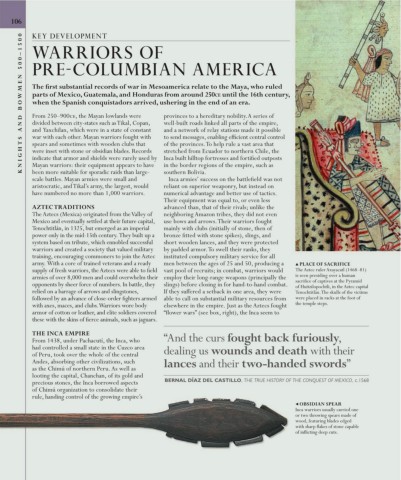
            army.  With a core of trained veterans and a ready   men between the ages of 25 and 50, producing a   ▲ PLACE OF SACRIFICE
            supply of fresh warriors, the Aztecs were able to field  vast pool of recruits; in combat, warriors would   The Aztec ruler Axayacatl (1468–81)
            armies of over 8,000 men and could overwhelm their  employ their long-range weapons (principally the   is seen presiding over a human
            opponents by sheer force of numbers. In battle, they   slings) before closing in for hand-to-hand combat.   sacrifice of captives at the Pyramid
                                                                                                          of Huitzilopochtli, in the Aztec capital
            relied on a barrage of arrows and slingstones,   If they suffered a setback in one area, they were   Tenochtitlán. The skulls of the victims
            followed by an advance of close-order fighters armed  able to call on substantial military resources from   were placed in racks at the foot of
            with axes, maces, and clubs. Warriors wore body   elsewhere in the empire. Just as the Aztecs fought   the temple steps.
            armor of cotton or leather, and elite soldiers covered  “flower wars” (see box, right), the Inca seem to
            these with the skins of fierce animals, such as jaguars.


            THE INCA EMPIRE                                “And the curs fought back furiously,
            From 1438, under Pachacutí, the Inca, who
            had controlled a small state in the Cuzco area    dealing us wounds and death with their
            of Peru, took over the whole of the central
            Andes, absorbing other civilizations, such     lances and their two-handed swords”
            as the Chimú of northern Peru. As well as
            looting the capital, Chanchan, of its gold and
            precious stones, the Inca borrowed aspects      BERNAL DÍAZ DEL CASTILLO, THE TRUE HISTORY OF THE CONQUEST OF MEXICO, c.1568
            of Chimú organization to consolidate their
            rule, handing control of the growing empire’s
                                                                                                          ◀ OBSIDIAN SPEAR
                                                                                                          Inca warriors usually carried one
                                                                                                          or two throwing spears made of
                                                                                                          wood, featuring blades edged
                                                                                                          with sharp flakes of stone capable
                                                                                                          of inflicting deep cuts.

