


Page 105 - (DK) Smithsinian - Military History: The Definitive Visual Guide to the Objects of Warfare
P. 105
103

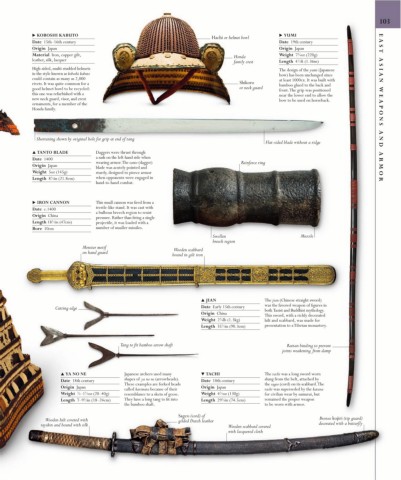
            ▶ KOBOSHI KABUTO                                                                         ▶ YUMI
                                                                            Hachi or helmet bowl
            Date  15th–16th century                                                                  Date  19th century
            Origin  Japan                                                                            Origin  Japan
                                                                                                           3
            Material  Iron, copper gilt,                                            Honda            Weight  7 ⁄4oz (220g)
            leather, silk, lacquer                                                                         1
                                                                                    family crest     Length  4 ⁄2ft (1.36m)
            High-sided, multi-studded helmets                                                        The design of the yumi (Japanese
            in the style known as koboshi kabuto                                                     bow) has been unchanged since
            could contain as many as 2,000                                                           at least 1000ce. It was built with
            rivets. It was quite common for a                                         Shikoro        bamboo glued to the back and
            good helmet bowl to be recycled:                                          or neck guard  front. The grip was positioned
            this one was refurbished with a                                                          near the lower end to allow the
            new neck guard, visor, and crest                                                         bow to be used on horseback.
            ornaments, for a member of the
            Honda family.                                                                                                               EAST ASIAN  WEAPONS AND ARMOR


              Shortening shown by original hole for grip at end of tang
                                                                                                Flat-sided blade without a ridge
            ▲ TANTO BLADE          Daggers were thrust through
            Date  1400             a sash on the left-hand side when
                                   wearing armor. The tanto (dagger)                   Reinforce ring
            Origin  Japan
                                   blade was acutely pointed and
            Weight  5oz (145g)     sturdy, designed to pierce armor
                   1
            Length  8 ⁄2in (21.8cm)  when opponents were engaged in
                                   hand-to-hand combat.
            ▶ IRON CANNON          This small cannon was fired from a
            Date  c.1400           trestle-like stand. It was cast with
                                   a bulbous breech region to resist
            Origin  China
                                   pressure. Rather than firing a single
                   1
            Length 18 ⁄2in (47cm)  projectile, it was loaded with a
            Bore  10cm             number of smaller missiles.
                                                                             Swollen                        Muzzle
                                                                             breech region
                              Monster motif                    Wooden scabbard
                              on hand guard
                                                              bound in gilt iron


                                                                         ▲ JIAN                The jian (Chinese straight sword)
                     Cutting edge                                        Date  Early 15th century  was the favored weapon of figures in
                                                                                               both  Taoist and Buddhist mythology.
                                                                         Origin  China
                                                                                               This sword, with a richly decorated
                                                                         Weight  2 ⁄4lb (1.3kg)  hilt and scabbard, was made for
                                                                               3
                                                                         Length  35 ⁄2in (90.3cm)  presentation to a Tibetan monastery.
                                                                                1
                                            Tang to fit bamboo arrow shaft                             Rattan binding to prevent
                                                                                                      joints weakening  from damp


                       ▲ YA NO NE            Japanese archers used many    ▼ TACHI             The tachi was a long sword worn
                       Date  18th century    shapes of  ya no ne (arrowheads).   Date  18th century  slung from the belt, attached by
                                             These examples are forked heads                   the sageo (cord) on its scabbard. The
                       Origin  Japan         called karimata because of their   Origin  Japan  tachi was superseded by the katana
                                                                               1
                               1
                            3
                       Weight   ⁄4–1 ⁄2oz (20–40g)  resemblance to a skein of geese.    Weight  4 ⁄2oz (130g)  for civilian wear by samurai, but
                               1
                                                                                1
                       Length  7–9 ⁄2in (18–24cm)  They have a long tang to fit into    Length  29 ⁄4in (74.5cm)  remained the proper weapon
                                             the bamboo shaft.                                 to be worn with armor.
                                                                 Sageo (cord) of
                 Wooden hilt covered with                        gilded Dutch leather                              Bronze kojiri (tip guard)
               rayskin and bound with silk                                        Wooden scabbard covered          decorated with a butterfly
                                                                                  with lacquered cloth

