


Page 103 - (DK) Smithsinian - Military History: The Definitive Visual Guide to the Objects of Warfare
P. 103
101

                                                               STEPPE HORSEMEN
                                                               THE MONGOLS


                                                               AT WAR                                                                   THE MONGOLS


                                                               Under the leadership of Genghis Khan from the early 13th
                                                               century, the Mongols created the largest empire in history.
                                                               Their secret was the ability to blend the traditional fighting           A
                                                               tactics of nomadic horsemen with technology adopted from                 T  W
                                                               the settled civilizations that they subjugated.                          AR


                                                               Born Temüjin, the son of a tribal chief,  to augment their traditional mounted
                                                               the future Genghis Khan spent two   bowmen with armored cavalry
                                                               decades uniting the various Mongol   equipped with swords and lances, and
                                                               and Turkic peoples of eastern Central   protected by metal armor, instead of
                                                               Asia. Although they had similar     their usual felt or silk tunics. Rather
                                                               lifestyles—living in tents and in    than avoiding close combat, this heavy
                                                               close proximity to their horses—the   cavalry would charge an enemy
                                                               Mongols, Merkits, Naimans, Keraits,   already weakened by the bowmen,
                                                               Tatars, and Uighurs were traditionally   and deliver the final, crushing blow.
                                                               hostile to one another. However, using   Overall, their approach to warfare
                                                               a combination of savage warfare and   was ruthlessly practical: they would
                                                               cunning diplomacy, Temüjin united   lure the enemy into a position of
                                                               them into a vast steppe confederation.   weakness, then destroy them. Speed
                                                               In 1206, the tribes formally        of maneuver was therefore of the
                                                               acknowledged his authority and      essence. Traveling light and living
                                                               he assumed the title Genghis Khan,    off the land, they could overcome
                                                               or “lord of all.” With a huge army at    the more cumbersome armies of
                                                               his disposal, Genghis embarked on   settled civilizations.
                                                               campaigns that reached from Beijing
                                                               (Zhongdu) in China, to the wealthy   THE OLD AND THE NEW
                                                               Central Asian cities of Samarkand and   However, if traditional steppe warfare
                                                               Bukhara (in modern-day Uzbekistan),   was the foundation for Genghis
                                                               before his death in 1227.           Khan’s empire, then its expansion
                                                                  The Mongols’ style of warfare    was strongly based on new technology
                                                               originated from hunting. With their   adopted from conquered territories
                                                               powerful composite bows and sturdy,   in China and the Muslim world. From
                                                               nimble horses, large groups of riders   Beijing in 1214–15 to Baghdad in
                                                               would pursue herds across the steppe,   1258, the Mongols demonstrated
                                                               then encircle and kill the animals with  their skill at siege warfare, battering
                                                               arrows; this is also how they attacked   city walls with projectiles hurled by
                                                               their enemy in battle. The Mongols had  mangonels and trebuchets. They were
                                                               none of the obsession with personal   also pioneers in the use of gunpowder
                                                               bravery and honor that governed     as a military explosive and incendiary
                                                               medieval European knights at the    material, using primitive bombs
                                                               time. A traditional steppe horseman   hurled by catapult, and handheld
                                                               would use his bow to kill from a    devices that were ancestors of the
                                                               distance whenever possible, instead    flamethrower and the handgun.
                                                               of risking his life in a close-quarters   At their peak the Mongols were a
                                                               encounter. Similarly, Mongol        near-unstoppable military force, but
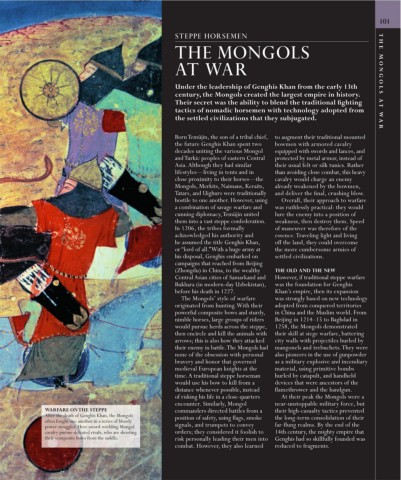
                 WARFARE ON THE STEPPE                         commanders directed battles from a   their high-casualty tactics prevented
                 After the death of Genghis Khan, the Mongols   position of safety, using flags, smoke   the long-term consolidation of their
                 often fought one another in a series of bloody   signals, and trumpets to convey   far-flung realms. By the end of the
                 power struggles. Here sword-wielding Mongol
                 cavalry pursue defeated rivals, who are shooting   orders; they considered it foolish to   14th century, the mighty empire that
                 their composite bows from the saddle.         risk personally leading their men into  Genghis had so skillfully founded was
                                                               combat. However, they also learned   reduced to fragments.

