


Page 116 - (DK) Smithsinian - Military History: The Definitive Visual Guide to the Objects of Warfare
P. 116
INTRODUCTION


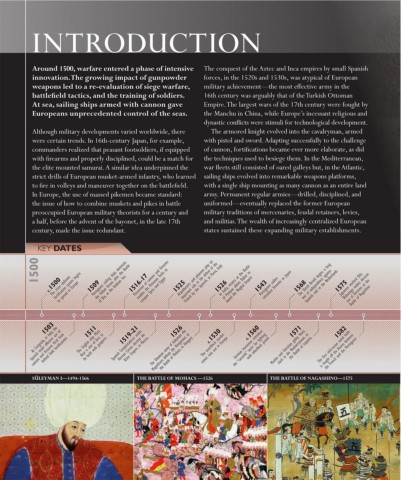
            Around 1500, warfare entered a phase of intensive             The conquest of the Aztec and Inca empires by small Spanish
            innovation. The growing impact of gunpowder                   forces, in the 1520s and 1530s, was atypical of European
            weapons led to a re-evaluation of siege warfare,              military achievement—the most effective army in the
            battlefield tactics, and the training of soldiers.            16th century was arguably that of the Turkish Ottoman
            At sea, sailing ships armed with cannon gave                  Empire. The largest wars of the 17th century were fought by
            Europeans unprecedented control of the seas.                  the Manchu in China, while Europe’s incessant religious and
                                                                          dynastic conflicts were stimuli for technological development.
            Although military developments varied worldwide, there           The armored knight evolved into the cavalryman, armed
            were certain trends. In 16th-century Japan, for example,      with pistol and sword. Adapting successfully to the challenge
            commanders realized that peasant footsoldiers, if equipped    of cannon, fortifications became ever more elaborate, as did
            with firearms and properly disciplined, could be a match for   the techniques used to besiege them. In the Mediterranean,
            the elite mounted samurai. A similar idea underpinned the     war fleets still consisted of oared galleys but, in the Atlantic,
            strict drills of European musket-armed infantry, who learned  sailing ships evolved into remarkable weapons platforms,
            to fire in volleys and maneuver together on the battlefield.    with a single ship mounting as many cannon as an entire land
            In Europe, the use of massed pikemen became standard:         army. Permanent regular armies—drilled, disciplined, and
            the issue of how to combine muskets and pikes in battle       uniformed—eventually replaced the former European
            preoccupied European military theorists for a century and     military traditions of mercenaries, feudal retainers, levies,
            a half, before the advent of the bayonet, in the late 17th    and militias. The wealth of increasingly centralized European
            century, made the issue redundant.                            states sustained these expanding military establishments.


              KEY DATES
              1500                Portuguese sailing ships dominate   Possession of cannon and firearms   Arquebusiers and pikemen play an
                                                                  important role in the defeat of the
                                                                                                            The Dutch Revolt begins a long
                                   the Indian Ocean, after the Battle
                                                  enables the Ottoman Turks to
                                                                                                             war of independence against
                                                                                 of Panipat allows Babur to
                     fortification system begins
                                                                                                                            Nobunaga makes decisive
                                                                                               introduce firearms to Japan
                                                                                                                           Japanese warlord Oda
                   The trace italienne
                                                                                              Portuguese sailors
                                                                                  found the Mughal Empire
                                                   conquer Syria and Egypt
                  c.1500         1509  of Diu, in the Arabian Sea  1516–17   1525  French by the Spanish, at Pavia, Italy In India, victory at the Battle    1543   1568  Spanish rule in the Netherlands  1575  use of firearms at the
                      to spread in Europe
                                                                              1526
                                                                                                                              Battle of Nagashino
                 1503
             At Cerignola, in Italy, the
                                            1519–21
                                                                                         c.1560
                                1511
                                                                                                         1571
                                                               1526
                                                                                                                         1582
                                                                                     German horsemen introduce
            Spanish make effective use of     The English ship Mary   Spanish Conquistadores under      The Ottoman army of Suleyman the   The matchlock musket   the “caracole” tactic for fighting    Muslim and Christian galley fleets   The first mid-ocean naval batle
                                                                           c.1530
                                                                                                    clash in the Mediterranean, at
                              Rose is one of first to
             cannon and firearms fired from
                                                        Magnificent defeats the Hungarians at
                                           Hernan Cortes destroy the
                                                                                                                    is fought off the Azores between
                behind field fortifications
                                              Aztec Empire, in Mexico
                               be built with gunports
                                                          the Battle of Mohacs, in Hungary
                                                                                                         the Battle of Lepanto
                                                                                         with wheellock pistols
                                                                         comes into use in Europe
                                                                                                                     the French and the Portuguese
            SÜLEYMAN I—1494-1566                  THE BATTLE OF MOHACS —1526                     THE BATTLE OF NAGASHINO—1575

