


Page 120 - (DK) Smithsinian - Military History: The Definitive Visual Guide to the Objects of Warfare
P. 120
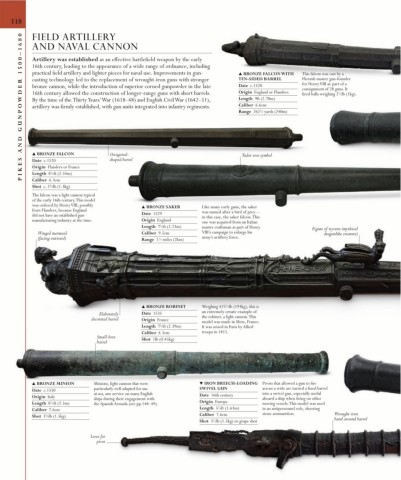
118    FIELD ARTILLERY

         WDER 1500–1680  AND NAVAL CANNON                                             ▲ BRONZE FALCON WITH   This falcon was cast by a


            Artillery was established as an effective battlefield weapon by the early
            16th century, leading to the appearance of a wide range of ordnance, including
            practical field artillery and lighter pieces for naval use. Improvements in gun-
            casting technology led to the replacement of wrought-iron guns with stronger
                                                                                                             Flemish master gun-founder
                                                                                      TEN-SIDED BARREL
                                                                                                             for Henry VIII as  part of a
                                                                                      Date  c.1520
            bronze cannon, while the introduction of superior corned gunpowder in the late
                                                                                                             consignment of 28 guns. It
                                                                                      Origin  England or Flanders
            16th century allowed the construction of longer-range guns with short barrels.
                                                                                                                          1
                                                                                                             fired balls weighing 2 ⁄4lb (1kg).
                                                                                      Length  9ft (2.78m)
         AND GUNPO  By the time of the  Thirty  Years’ War (1618–48) and English Civil War (1642–51),   Caliber  6.6cm
            artillery was firmly established, with gun units integrated into infantry regiments.
                                                                                      Range  262 ⁄2 yards (240m)
                                                                                              1
         PIKES   ▲ BRONZE FALCON        Octagonal-                                     Tudor rose symbol
                                        shaped barrel
            Date  c.1520
            Origin  Flanders or France
            Length  8 ⁄4ft (2.54m)
                   1
            Caliber  6.3cm
                   3
            Shot  c. 2 ⁄4lb (1.3kg)
            The falcon was a light cannon typical
            of the early 16th century. This model
            was ordered by Henry VIII, possibly    ▲ BRONZE SAKER        Like many early guns, the saker
            from Flanders, because England                               was named after a bird of prey—
            did not have an established gun-       Date  1529            in this case, the saker falcon. This
            manufacturing industry at the time.    Origin  England       one was acquired from an Italian
                                                          1
                                                   Length  7 ⁄4ft (2.23m)  master craftsman as part of Henry    Figure of wyvern (mythical
              Winged mermaid                       Caliber  9.5cm        VIII’s campaign to enlarge his              dragonlike creature)
              (facing outward)                     Range  1 ⁄2 miles (2km)  army’s artillery force.
                                                         1


                                                                                 1
                                                   ▲ BRONZE ROBINET      Weighing 425 ⁄2lb (193kg), this is
                                    Elaborately    Date  1535            an extremely ornate example of
                                                                         the robinet, a light cannon. This
                                 decorated barrel  Origin  France        model was made in Metz, France.
                                                          3
                                                   Length  7 ⁄4ft (2.39m)  It was seized in Paris by Allied
                                                   Caliber  4.3cm        troops in 1815.
                                   Small-bore
                                   barrel          Shot  1lb (0.45kg)


            ▲ BRONZE MINION       Minions, light cannon that were       ▼ IRON BREECH-LOADING  Pivots that allowed a gun to fire
            Date  c.1550          particularly well adapted for use     SWIVEL GUN             across a wide arc turned a fixed barrel
                                  at sea, saw service on many English                          into a swivel gun, especially useful
            Origin  Italy         ships during their engagement with    Date  16th century     aboard a ship when firing on other
            Length  8 ⁄4ft (2.5m)  the Spanish Armada (see pp.148–49).  Origin  Europe         moving vessels. This model was used
                   1
                                                                               1
            Caliber  7.6cm                                              Length  5 ⁄4ft (1.63m)  in an antipersonnel role, shooting
                 1
            Shot  3 ⁄4lb (1.5kg)                                        Caliber  7.6cm         stone ammunition.        Wrought-iron
                                                                             1
                                                                        Shot  3 ⁄2lb (1.5kg) or grape shot              band around barrel
                                 Lever for
                                   pivot

