


Page 118 - (DK) Smithsinian - Military History: The Definitive Visual Guide to the Objects of Warfare
P. 118
116    KEY DEVELOPMENT

         WDER 1500–1680  PIKES AND MUSKETS


            In the 16th and 17th centuries, Europe was a continent almost constantly
            at war. Over the course of these decades of conflict, European armies
            experimented with fighting methods that bestowed new importance
            on infantry armed with pikes and firearms.

         AND GUNPO  Medieval European foot soldiers were often   enemy pike square or help hold off a cavalry
                                                           charge. Mobile field cannon—of bronze and
            effective but were generally seen as being of low
            repute. In the early 16th century, however, the
                                                           firing iron shot—also began to make their mark
                                                           on the battlefield.
            Renaissance rediscovery of the military techniques
            of Ancient Greece and Rome—the Greek phalanx
            and the Roman legion—suddenly made infantry
                                                           INFANTRY DISCIPLINE
         PIKES   fashionable. The most admired fighting men    When they could afford it, 16th-century
                                                           infantry wore extensive plate armor for
            of 16th-century Europe, such as the German
                                                           protection against arquebus fire, as well
            Landesknechte and the Spanish tercios, fought
            on foot, utilizing massed bodies of pikemen. This
                                                           as against pikes, swords, and halberds. But
            technique had been pioneered by the Swiss, but
                                                           the matchlock musket came into use. A
            now firearms were added to the formations:     during the second half of the 16th century,
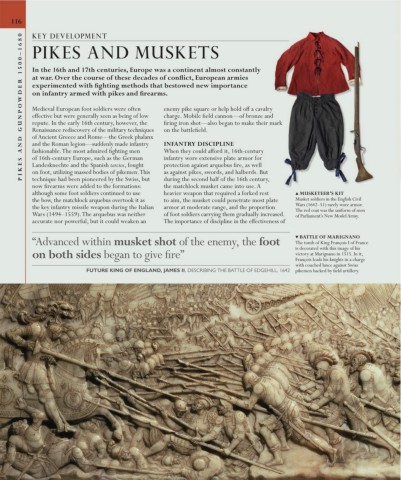
            although some foot soldiers continued to use    heavier weapon that required a forked rest    ▲ MUSKETEER’S KIT
            the bow, the matchlock arquebus overtook it as    to aim, the musket could penetrate most plate   Musket soldiers in the English Civil
            the key infantry missile weapon during the Italian   armor at moderate range, and the proportion    Wars (1642–51) rarely wore armor.
                                                                                                          The red coat was the uniform of men
            Wars (1494–1559). The arquebus was neither     of foot soldiers carrying them gradually increased.   of Parliament’s New Model Army.
            accurate nor powerful, but it could weaken an   The importance of discipline in the effectiveness of

            “Advanced within musket shot of the enemy, the foot                                           ▼ BATTLE OF MARIGNANO
                                                                                                          The tomb of King François I of France
                                                                                                          is decorated with this image of his
            on both sides began to give fire”                                                             victory at Marignano in 1515. In it,
                                                                                                          François leads his knights in a charge
                                                                                                          with couched lance against Swiss
                                FUTURE KING OF ENGLAND, JAMES II, DESCRIBING THE BATTLE OF EDGEHILL, 1642  pikemen backed by field artillery.

