


Page 119 - (DK) Smithsinian - Military History: The Definitive Visual Guide to the Objects of Warfare
P. 119
117

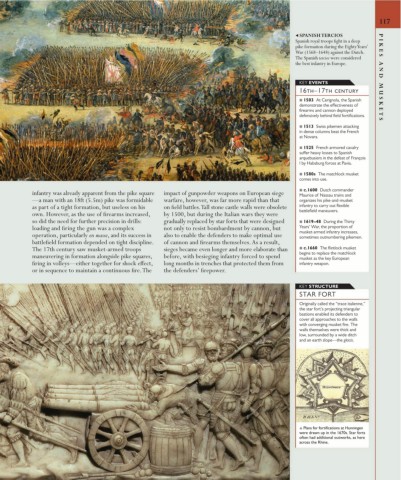
                                                                                                          ◀ SPANISH TERCIOS
                                                                                                          Spanish royal troops fight in a deep
                                                                                                          pike formation during the Eighty Years’
                                                                                                          War (1568–1648) against the Dutch.
                                                                                                          The Spanish tercios were considered   PIKES AND
                                                                                                          the best infantry in Europe.


                                                                                                            KEY EVENTS
                                                                                                            16th–17th century
                                                                                                            ◼ 1503  At Cerignola, the Spanish   MUSKETS
                                                                                                            demonstrate the effectiveness of
                                                                                                            firearms and cannon deployed
                                                                                                            defensively behind field fortifications.

                                                                                                            ◼ 1513  Swiss pikemen attacking
                                                                                                            in dense columns beat the French
                                                                                                            at Novara.
                                                                                                            ◼ 1525  French armored cavalry
                                                                                                            suffer heavy losses to Spanish
                                                                                                            arquebusiers in the defeat of François
                                                                                                            I by Habsburg forces at Pavia.
                                                                                                            ◼ 1580s  The matchlock musket
                                                                                                            comes into use.

            infantry was already apparent from the pike square   impact of gunpowder weapons on European siege   ◼ c.1600  Dutch commander
                                                                                                            Maurice of Nassau trains and
            —a man with an 18ft (5.5m) pike was formidable   warfare, however, was far more rapid than that    organizes his pike-and-musket
            as part of a tight formation, but useless on his   on field battles. Tall stone castle walls were obsolete   infantry to carry out flexible
            own. However, as the use of firearms increased,    by 1500, but during the Italian wars they were   battlefield maneuvers.
            so did the need for further precision in drills:   gradually replaced by star forts that were designed   ◼ 1619–48  During the Thirty
            loading and firing the gun was a complex       not only to resist bombardment by cannon, but    Years’ War, the proportion of
            operation, particularly en masse, and its success in   also to enable the defenders to make optimal use    musket-armed infantry increases,
                                                                                                            sometimes outnumbering pikemen.
            battlefield formation depended on tight discipline.   of cannon and firearms themselves. As a result,
            The 17th century saw musket-armed troops       sieges became even longer and more elaborate than   ◼ c.1660  The flintlock musket
                                                                                                            begins to replace the matchlock
            maneuvering in formation alongside pike squares,   before, with besieging infantry forced to spend   musket as the key European
            firing in volleys—either together for shock effect,   long months in trenches that protected them from   infantry weapon.
            or in sequence to maintain a continuous fire. The   the defenders’ firepower.


                                                                                                            KEY STRUCTURE
                                                                                                            STAR FORT
                                                                                                            Originally called the “trace italienne,”
                                                                                                            the star fort’s projecting triangular
                                                                                                            bastions enabled its defenders to
                                                                                                            cover all approaches to the walls
                                                                                                            with converging musket fire. The
                                                                                                            walls themselves were thick and
                                                                                                            low, surrounded by a wide ditch
                                                                                                            and an earth slope—the glacis.


                                                                                                            ▲ Plans for fortifications at Hunningen
                                                                                                            were drawn up in the 1670s. Star forts
                                                                                                            often had additional outworks, as here
                                                                                                            across the Rhine.

