


Page 148 - (DK) Smithsinian - Military History: The Definitive Visual Guide to the Objects of Warfare
P. 148
146    SAMURAI AND FOOT SOLDIERS

         WDER 1500–1680  THE SIEGE OF


            OSAKA CASTLE


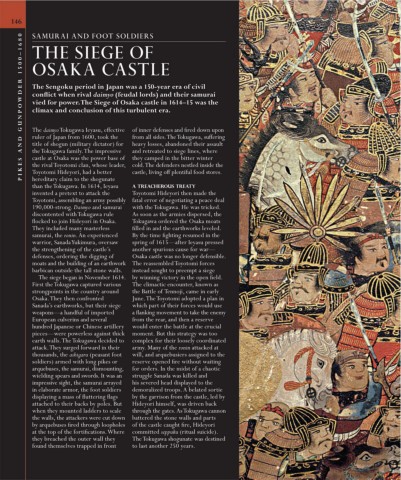
            The Sengoku period in Japan was a 150-year era of civil
            conflict when rival daimyo (feudal lords) and their samurai

         AND GUNPO  vied for power. The Siege of Osaka castle in 1614–15 was the
            climax and conclusion of this turbulent era.


            The daimyo Tokugawa Ieyasu, effective  of inner defenses and fired down upon
            ruler of Japan from 1600, took the
                                                from all sides. The Tokugawa, suffering
                                                heavy losses, abandoned their assault
            title of shogun (military dictator) for
         PIKES   the Tokugawa family. The impressive   and retreated to siege lines, where
            castle at Osaka was the power base of  they camped in the bitter winter
            the rival Toyotomi clan, whose leader,  cold. The defenders nestled inside the
                                                castle, living off plentiful food stores.
            Toyotomi Hideyori, had a better
            hereditary claim to the shogunate
            than the Tokugawa. In 1614, Ieyasu   A TREACHEROUS TREATY
            invented a pretext to attack the    Toyotomi Hideyori then made the
            Toyotomi, assembling an army possibly  fatal error of negotiating a peace deal
            190,000-strong. Daimyo and samurai   with the Tokugawa. He was tricked.
            discontented with Tokugawa rule     As soon as the armies dispersed, the
            flocked to join Hideyori in Osaka.   Tokugawa ordered the Osaka moats
            They included many masterless       filled in and the earthworks leveled.
            samurai, the ronin. An experienced   By the time fighting resumed in the
            warrior, Sanada Yukimura, oversaw   spring of 1615—after Ieyasu pressed
            the strengthening of the castle’s   another spurious cause for war—
            defenses, ordering the digging of   Osaka castle was no longer defensible.
            moats and the building of an earthwork  The reassembled Toyotomi forces
            barbican outside the tall stone walls.   instead sought to preempt a siege
               The siege began in November 1614.  by winning victory in the open field.
            First the Tokugawa captured various   The climactic encounter, known as
            strongpoints in the country around   the Battle of  Tennoji, came in early
            Osaka. They then confronted         June. The Toyotomi adopted a plan in
            Sanada’s earthworks, but their siege   which part of their forces would use
            weapons—a handful of imported       a flanking movement to take the enemy
            European culverins and several      from the rear, and then a reserve
            hundred Japanese or Chinese artillery  would enter the battle at the crucial
            pieces—were powerless against thick  moment. But this strategy was too
            earth walls. The Tokugawa decided to  complex for their loosely coordinated
            attack. They surged forward in their   army. Many of the ronin attacked at
            thousands, the ashigaru (peasant foot   will, and arquebusiers assigned to the
            soldiers) armed with long pikes or   reserve opened fire without waiting
            arquebuses, the samurai, dismounting,   for orders. In the midst of a chaotic
            wielding spears and swords. It was an   struggle Sanada was killed and
            impressive sight, the samurai arrayed   his severed head displayed to the
            in elaborate armor, the foot soldiers   demoralized troops. A belated sortie
            displaying a mass of fluttering flags   by the garrison from the castle, led by
            attached to their backs by poles. But   Hideyori himself, was driven back
            when they mounted ladders to scale   through the gates. As Tokugawa cannon
            the walls, the attackers were cut down  battered the stone walls and parts
            by arquebuses fired through loopholes   of the castle caught fire, Hideyori
            at the top of the fortifications. Where  committed seppuku (ritual suicide).
            they breached the outer wall they   The Tokugawa shogunate was destined
            found themselves trapped in front    to last another 250 years.

