


Page 143 - (DK) Smithsinian - Military History: The Definitive Visual Guide to the Objects of Warfare
P. 143
141


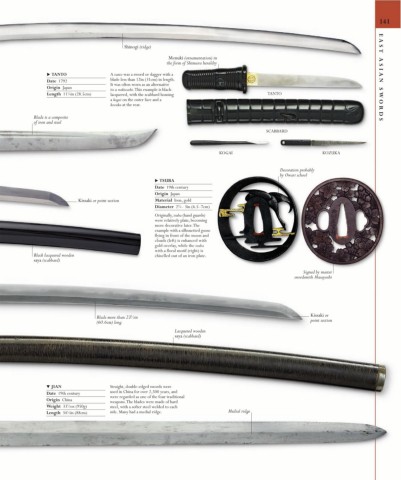
                                             Shinogi (ridge)
                                                             Menuki (ornamentation) in                                                  EAST ASIAN
                                                            the form of Shimazu heraldry
                  ▶ TANTO               A tanto was a sword or dagger with a
                  Date  1792            blade less than 12in (31cm) in length.
                                        It was often worn as an alternative
                  Origin  Japan
                                        to a wakizashi. This example is black-
                         1
                  Length  11 ⁄4in (28.5cm)  lacquered, with the scabbard housing                TANTO                                   SW
                                        a kogai on the outer face and a
                                        kozuka at the rear.                                                                             ORDS
             Blade is a composite
             of iron and steel
                                                                                                SCABBARD


                                                                               KOGAI                                KOZUKA


                                                                                                     Decoration probably
                                                                                                     by Owari school
                                                        ▶ TSUBA
                                                        Date  19th century
                                                        Origin  Japan
                             Kissaki or point section   Material  Iron, gold
                                                        Diameter  2 ⁄4– 3in (6.5–7cm)
                                                                3
                                                        Originally, tsuba (hand guards)
                                                        were relatively plain, becoming
                                                        more decorative later. The
                                                        example with a silhouetted goose
                                                        flying in front of the moon and
                                                        clouds (left) is enhanced with
                                                        gold overlay, while the tsuba
                                                        with a floral motif (right) is
             Black lacquered wooden                     chiselled out of an iron plate.
             saya (scabbard)

                                                                                                             Signed by master
                                                                                                          swordsmith Masayoshi


                                                1
                                   Blade more than 23 ⁄2in                                                      Kissaki or
                                   (60.6cm) long                                                                point section
                                                               Lacquered wooden
                                                               saya (scabbard)


                 ▼ JIAN                 Straight, double-edged swords were
                 Date  19th century     used in China for over 2,500 years, and
                                        were regarded as one of the four traditional
                 Origin  China
                                        weapons. The blades were made of hard
                 Weight  33 ⁄2oz (950g)  steel, with a softer steel welded to each
                         1
                         1
                 Length  34 ⁄2in (88cm)  side. Many had a medial ridge.           Medial ridge

