


Page 146 - (DK) Smithsinian - Military History: The Definitive Visual Guide to the Objects of Warfare
P. 146
144    JAPANESE ARMOR                                                                 Supports for

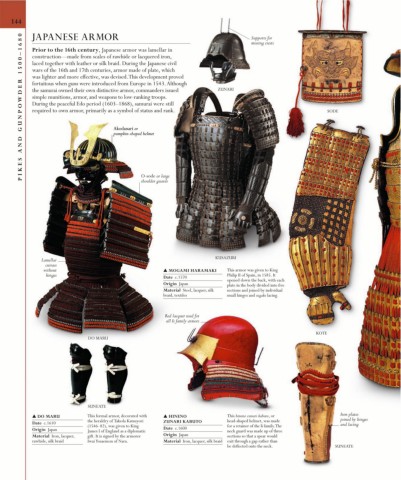
         WDER 1500–1680  Prior to the 16th century, Japanese armor was lamellar in   ZUNARI
                                                                                           missing crests

            construction—made from scales of rawhide or lacquered iron,
            laced together with leather or silk braid. During the Japanese civil
            wars of the 16th and 17th centuries, armor made of plate, which
            was lighter and more effective, was devised. This development proved
            fortuitous when guns were introduced from Europe in 1543. Although
            the samurai owned their own distinctive armor, commanders issued
            simple munitions, armor, and weapons to low-ranking troops.
         AND GUNPO  During the peaceful Edo period (1603–1868), samurai were still                                    SODE
            required to own armor, primarily as a symbol of status and rank.


                                                i
                                         Ak
                                           odanar
                                         Akodanari or
                                                 or
                                         pumpkin-shaped helmet
                                         pumpkin-shaped helmet
         PIKES                                     O-sode or large


                                                   shoulder guards


                                                                              KUSAZURI
                Lamellar
                 cuirass
                without                                    ▲ MOGAMI HARAMAKI      This armor was given to King
                 hinges                                    Date  c.1570           Philip II of Spain, in 1585. It
                                                                                  opened down the back, with each
                                                           Origin  Japan          plate in the body divided into five
                                                           Material  Steel, lacquer, silk   sections and joined by individual
                                                           braid, textiles        small hinges and sugake lacing.


                                                            Red lacquer used for
                                                            all Ii family armors

                                                                                                                  KOTE
                                DO MARU


                                SUNEATE
            ▲ DO MARU           This formal armor, decorated with   ▲ HINENO      This hineno zunari kabuto, or           Iron plates
                                the heraldry of  Takeda Katsuyori   ZUNARI KABUTO   head-shaped helmet, was made          joined by hinges
            Date  c.1610                                                                                                  and lacing
                                (1546–82), was given to King                      for a retainer of the Ii family. The
            Origin  Japan       James I of England as a diplomatic   Date  c.1600  neck guard was made up of three
            Material  Iron, lacquer,   gift. It is signed by the armorer   Origin  Japan  sections so that a spear would
            rawhide, silk braid  Iwai  Yosaemon of Nara.   Material  Iron, lacquer, silk braid  exit through a gap rather than
                                                                                  be deflected onto the neck.           SUNEATE

