


Page 144 - (DK) Smithsinian - Military History: The Definitive Visual Guide to the Objects of Warfare
P. 144
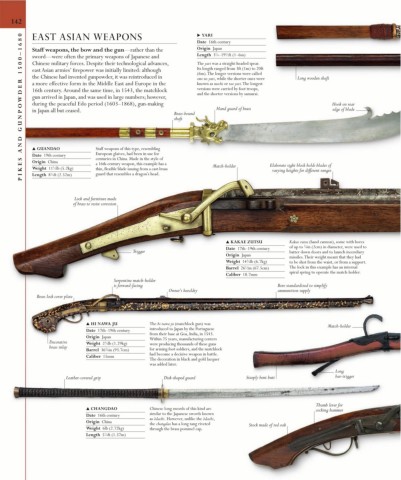
142    EAST ASIAN WEAPONS                                         ▶ YARI

         WDER 1500–1680  Staff weapons, the bow and the gun—rather than the   Origin  Japan  1             Long wooden shaft
                                                                       Date  16th century

                                                                              1
                                                                       Length  3 ⁄4–19 ⁄2ft (1–6m)
            sword—were often the primary weapons of Japanese and
            Chinese military forces. Despite their technological advances,
                                                                       The yari was a straight-headed spear.
                                                                       Its length ranged from 3ft (1m) to 20ft
            east Asian armies’ firepower was initially limited: although
                                                                       (6m). The longer versions were called
            the Chinese had invented gunpowder, it was reintroduced in
                                                                       omi no yari, while the shorter ones were
            a more effective form in the Middle East and Europe in the
                                                                       known as mochi or tae yari. The longest
                                                                       versions were carried by foot troops,
            16th century. Around the same time, in 1543, the matchlock
                                                                       and the shorter versions by samurai.
            gun arrived in Japan, and was used in large numbers; however,
         AND GUNPO  during the peaceful Edo period (1603–1868), gun-making    Brass-bound   Hand guard of brass        Hook on rear
                                                                                                                        edge of blade
            in Japan all but ceased.
                                                               shaft
            ▲ GUANDAO
                                   Staff weapons of this type, resembling
         PIKES   Date  19th century  European glaives, had been in use for    Match-holder       Elaborate sight block holds blades of
                                   centuries in China. Made in the style of
            Origin  China
                                   a 16th-century weapon, this example has a
            Weight  11 ⁄2lb (5.2kg)
                    1
                                   thin, flexible blade issuing from a cast-brass
                                                                                                  varying heights for different ranges
                                   guard that resembles a dragon’s head.
                   1
            Length  8 ⁄4ft (2.52m)
                           Lock and furniture made
                           of brass to resist corrosion


                                                                                  ▲ KAKAE ZUTSU         Kakae zutsu (hand cannon), some with bores
                                                                                                             3
                                                                                  Date  17th–19th century  of up to  ⁄4in (2cm) in diameter, were used to
                                                Trigger                                                 batter down doors and to launch incendiary
                                                                                  Origin  Japan         missiles. Their weight meant that they had
                                                                                  Weight  14 ⁄4lb (6.7kg)  to be shot from the waist, or from a support.
                                                                                         3
                                                                                        1
                                                                                  Barrel  26 ⁄2in (67.5cm)  The lock in this example has an internal
                                                                                                        spiral spring to operate the match-holder.
                                                                                  Caliber  18.7mm
                                         Serpentine match-holder
                                         is forward-facing                                          Bore standardized to simplify
                                                             Owner’s heraldry                       ammunition supply
              Brass lock cover plate


                                ▲ HI NAWA JU          The hi nawa ju (matchlock gun) was                              Match-holder
                                Date  17th–19th century  introduced to Japan by the Portuguese
                                                      from their base at Goa, India, in 1543.
                                Origin  Japan         Within 25 years, manufacturing centers
                  Decorative    Weight  2 ⁄4lb (1.29kg)  were producing thousands of these guns
                                      3
                  brass inlay
                                Barrel  36 ⁄4in (93.7cm)  for arming foot soldiers, and the matchlock
                                      3
                                                      had become a decisive weapon in battle.
                                Caliber  15mm
                                                      The decoration in black and gold lacquer
                                                      was added later.
                                                                                                                         Long
                        Leather-covered grip               Disk-shaped guard             Steeply bent butt               bar-trigger


                                                                                                                  Thumb lever for
                                ▲ CHANGDAO            Chinese long swords of this kind are                        cocking hammer
                                Date  16th century    similar to the Japanese swords known
                                                      as odachi. However, unlike the odachi,
                                                        ¯
                                                                         ¯
                                Origin  China         the changdao has a long tang riveted   Stock made of red oak
                                Weight  6lb (2.72kg)  through the brass pommel cap.
                                Length  5 ⁄4ft (1.57m)
                                      1

