


Page 178 - (DK) Smithsinian - Military History: The Definitive Visual Guide to the Objects of Warfare
P. 178
176      KEY FIGURE                 KEY DEVELOPMENT

         ONET 1680–1815  VAUBAN          THE DEVELOPMENT
              MARQUIS DE

              1633–1707
                                         OF SIEGE WARFARE
              France’s greatest military engineer,
              Vauban, directed his first siege in
              1657, aged 24. Having won the
              confidence of King Louis XIV,
              37 French fortresses and improved
                                         of sieges in Europe had become elaborate and formalized, and were the subject of
              more than 300. But he was, above
                                         learned treatises by renowned engineers, as well as the focus of military campaigns.
         Y    he oversaw the construction of    By the late 17th century, the construction of fortifications and the conduct
              all, valued for his innovative and
         AND BA  employing the system of saps    The introduction of cannon into European siege   that included the Dutch, there were 21 major
              aggressive conduct of sieges,
              and parallels.
                                         warfare from the 15th century triggered the rapid  sieges. Field battles resulted chiefly from efforts
                                         evolution in defensive fortifications. The challenge  to relieve ongoing sieges.
                                         was to make a fortress that was less vulnerable to
         FLINTLOCK                       capable of using cannon as a defensive armament.   Special weaponry evolved for siege warfare,
                                         cannon fire than the old stone castles, while being
                                                                                        WEAPONS OF WAR
                                                                                        including mortars that launched explosive shells
                                         In place of high castle walls, military engineers
                                                                                        over walls or into siege trenches, and grenades,
                                         developed a squat structure known as a “star fort”
                                                                                        which were hurled by a new type of elite soldier,
                                         (see p.117). This was a polygonal fortification, half
                                                                                        the grenadier. Engineers, such as Vauban and
                                         buried behind a deep, wide ditch, with bastions
                                                                                        his Dutch counterpart, Menno van Coehoorn,
                                         protruding at each angle. The bastions were wedge-
                                         shaped artillery platforms that provided an all-round  formalized and set out the conduct of sieges in
                                         field of fire, so that soldiers assaulting the walls, or  treatises. Despite this formality, the siege tactics
                                         another bastion, would come under fire from the
                                         flank or rear. A slope, or “glacis,” of earth in front of
                                         the ditch further protected the walls against cannon
                                         shot. This basic model was soon developed further,
                                         with outworks—fortifications built outside the
              ▲ After directing 48 sieges during the   fortress to delay or prevent besieging forces
              course of his career, Vauban retired in   advancing their guns and soldiers to the main walls.
              1703 with the rank of marshal.
                                         NEW STRUCTURES
                                         During the 17th century, the complexity of major
                                         fortifications left the simple “star fort” model
                                           behind. Triangular fortifications, or outworks,
                                            called “ravelins” (or “demi-lunes”) thrust forward
                                             between angle bastions. Vulnerable points
                                                 were defended by “hornworks”—defensive
                                                   structures comprising two bastions
                                                     joined by a short wall. Citadels were
                                                      built as backup forts within fortress
                                                       towns, where garrisons could
                                                        continue resistance after the
                                                        town had fallen. These complex
                                                        fortifications were expensive to
                                                        build and man. Many fortifications
                                                        were built by the Dutch Republic,
                                                        which was threatened first by
                                                       Spain in the Eighty Years’ War
                                                      (1568–1648) and then by France
                                                    in the wars of Louis XIV (reigned
                                                  1643–1715). Louis XIV, meanwhile,
                                              authorized his chief engineer, the Marquis
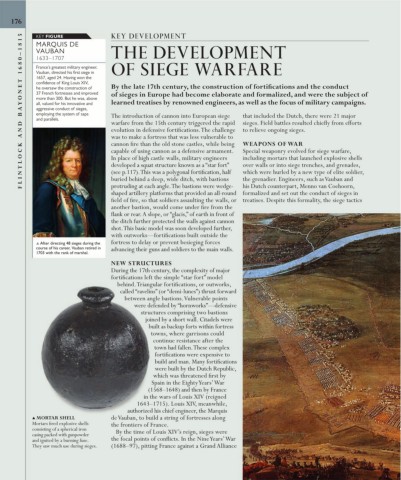
            ▲ MORTAR SHELL               de Vauban, to build a string of fortresses along
            Mortars fired explosive shells   the frontiers of France.
            consisting of a spherical iron    By the time of Louis XIV’s reign, sieges were
            casing packed with gunpowder
            and ignited by a burning fuse.    the focal points of conflicts. In the Nine Years’ War
            They saw much use during sieges.  (1688–97), pitting France against a Grand Alliance

