


Page 180 - (DK) Smithsinian - Military History: The Definitive Visual Guide to the Objects of Warfare
P. 180
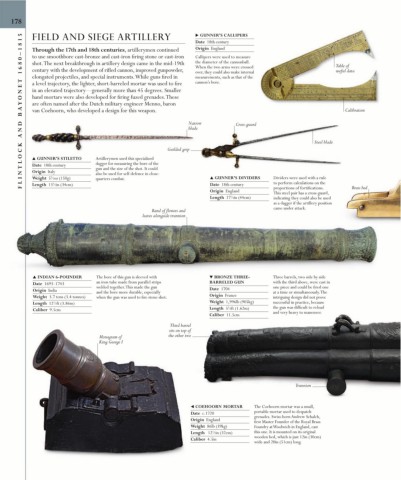
178    FIELD AND SIEGE ARTILLERY                                  ▶ GUNNER’S CALLIPERS

         ONET 1680–1815  Through the 17th and 18th centuries, artillerymen continued   Origin  England                   Table of
                                                                       Date  18th century

            to use smoothbore cast-bronze and cast-iron firing stone or cast-iron
                                                                       Callipers were used to measure
                                                                       the diameter of the cannonball.
            shot. The next breakthrough in artillery design came in the mid-19th
                                                                       When the two arms were crossed
            century with the development of rifled cannon, improved gunpowder,
                                                                                                                         useful data
                                                                       over, they could also make internal
            elongated projectiles, and special instruments. While guns fired in
                                                                       measurements, such as that of the
                                                                       cannon’s bore.
            a level trajectory, the lighter, short-barreled mortar was used to fire
            hand mortars were also developed for firing fuzed grenades. These
            are often named after the Dutch military engineer Menno, baron
         Y  in an elevated trajectory—generally more than 45 degrees. Smaller                                               Calibration
         AND BA                                                     Narrow           Cross-guard                 Steel blade
            van Coehoorn, who developed a design for this weapon.
                                                                    blade
         FLINTLOCK   ▲ GUNNER’S STILETTO  Artillerymen used this specialized    Guilded grip  ▲ GUNNER’S DIVIDERS  Dividers were used with a rule


                                   dagger for measuring the bore of the
            Date  18th century
                                   gun and the size of the shot. It could
            Origin  Italy
                                   also be used for self-defence in close-
                   1
            Weight  5 ⁄2oz (150g)
                                   quarters combat.
            Length  13 ⁄2in (34cm)
                                                                            Date  18th century
                    1
                                                                                                   proportions of fortifications.
                                                                            Origin  England        to perform calculations on the   Brass bed
                                                                                                   This steel pair has a cross-guard,
                                                                            Length  17 ⁄4in (44cm)  indicating they could also be used
                                                                                   1
                                                                                                   as a dagger if the artillery position
                                                                                                   came under attack.
                                                       Band of flowers and
                                                    leaves alongside trunnion


             ▲ INDIAN 6-POUNDER    The bore of this gun is sleeved with     ▼ BRONZE  THREE-      Three barrels, two side by side
             Date  1693–1743       an iron tube made from parallel strips   BARRELED GUN          with the third above, were cast in
                                   welded together. This made the gun                             one piece and could be fired one
             Origin  India                                                  Date  1704
                                   and the bore more durable, especially                          at a time or simultaneously. The
             Weight  3.7 tons (3.4 tonnes)  when the gun was used to fire stone shot.    Origin  France  intriguing design did not prove
                    1
             Length  12 ⁄2ft (3.86m)                                        Weight  1,996lb (905kg)  successful in practice, because
                                                                                  1
             Caliber  9.5cm                                                 Length  5 ⁄4ft (1.62m)   the gun was difficult to reload
                                                                            Caliber  11.5cm       and very heavy to maneuver.
                                                             Third barrel
                                                             sits on top of
                                    Monogram of              the other two
                                    King George I


                                                                                                          Trunnion


                                                                     ◀ COEHOORN MORTAR      The Coehoorn mortar was a small,
                                                                     Date  c.1720           portable mortar used to despatch
                                                                                            grenades. Swiss-born Andrew Schalch,
                                                                     Origin  England        first Master Founder of the Royal Brass
                                                                     Weight  86lb (39kg)    Foundry at Woolwich in England, cast
                                                                     Length   12 ⁄2in (32cm)  this one. It is mounted on its original
                                                                             1
                                                                                            wooden bed, which is just 12in (30cm)
                                                                     Caliber  4.5in
                                                                                            wide and 20in (51cm) long.

