


Page 179 - (DK) Smithsinian - Military History: The Definitive Visual Guide to the Objects of Warfare
P. 179
177


            of Louis XIV’s wars were aggressive and designed
            to produce a rapid result. These tactics involved   “The more powder we burn,
            digging trenches toward enemy fortifications in a
            zigzag, so that fire could not rake the trench from   the less blood we lose”
            end to end. At intervals, engineers dug transverse
            “parallels,” lines to which the siege cannon then     ATTRIBUTED TO MARQUIS DE VAUBAN, AT THE SIEGE OF CHARLEROI, 1693
            advanced. Under Vauban’s system, the third
            parallel was the last. From there, soldiers might                                             ◀ THE SACK OF MAGDEBURG
            emerge from their trenches, with grenadiers at                                                If defenders refused to surrender, they
            the fore, to mount an assault on the “covered                                                 faced massacre when fortifications   THE DEVELOPMENT OF SIEGE  W
            way”—the defensive position held by the enemy                                                 were taken by assault. At Magdeburg,
                                                                                                          in 1631, more than 20,000 people
            infantry, on the outer edge of the fortress’s ditch.                                          were killed when the city fell after
            Once this position was taken, siege cannon could                                              a six-month siege.
            advance close to the walls, and the defenders
            would be expected to surrender—a gesture
            rewarded by honorable treatment. Of course,
            actual sieges only approximated this pattern:
            for example, tunneling sappers might blow up
            walls using mines, or moats might be drained or
            crossed by soldiers on rafts.
              Ironically, despite the money lavished upon                                                                               ARF
            them, by the 18th century fortifications rarely
            resisted a siege for long. The golden age of siege                                                                          ARE
            warfare and fortifications was over by 1720.

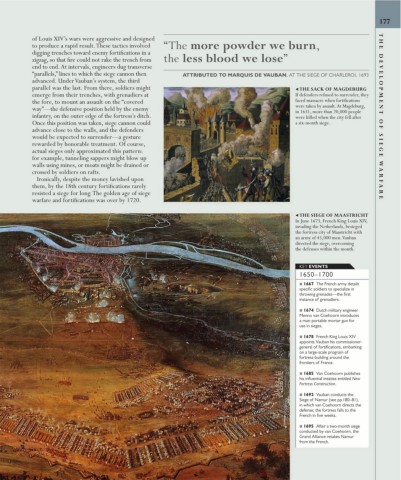
                                                                                                          ◀ THE SIEGE OF MAASTRICHT
                                                                                                          In June 1673, French King Louis XIV,
                                                                                                          invading the Netherlands, besieged
                                                                                                          the fortress city of Maastricht with
                                                                                                          an army of 45,000 men. Vauban
                                                                                                          directed the siege, overcoming
                                                                                                          the defenses within the month.


                                                                                                            KEY EVENTS
                                                                                                            1650–1700
                                                                                                            ◼ 1667  The French army details
                                                                                                            specific soldiers to specialize in
                                                                                                            throwing grenades—the first
                                                                                                            instance of grenadiers.
                                                                                                            ◼ 1674  Dutch military engineer
                                                                                                            Menno van Coehoorn introduces
                                                                                                            a man-portable mortar gun for
                                                                                                            use in sieges.
                                                                                                            ◼ 1678  French King Louis XIV
                                                                                                            appoints Vauban his commissioner-
                                                                                                            general of fortifications, embarking
                                                                                                            on a large-scale program of
                                                                                                            fortress-building around the
                                                                                                            frontiers of France.

                                                                                                            ◼ 1685  Van Coehoorn publishes
                                                                                                            his influential treatise entitled New
                                                                                                            Fortress Construction.
                                                                                                            ◼ 1692  Vauban conducts the
                                                                                                            Siege of Namur (see pp.180–81),
                                                                                                            in which van Coehoorn directs the
                                                                                                            defense; the fortress falls to the
                                                                                                            French in five weeks.
                                                                                                            ◼ 1695  After a two-month siege
                                                                                                            conducted by van Coehoorn, the
                                                                                                            Grand Alliance retakes Namur
                                                                                                            from the French.

