


Page 183 - (DK) Smithsinian - Military History: The Definitive Visual Guide to the Objects of Warfare
P. 183
181

                                                               EARLY MODERN SIEGE WARFARE
                                                               THE SIEGE


                                                               OF NAMUR


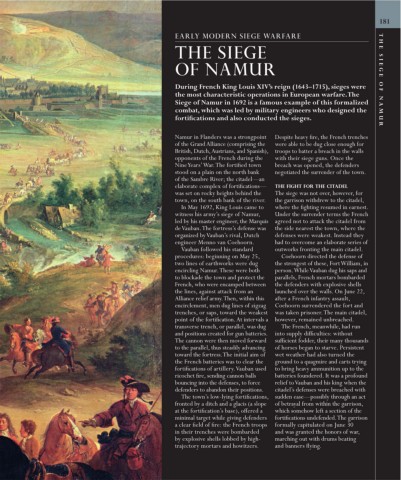
                                                               During French King Louis XIV’s reign (1643–1715), sieges were            THE SIEGE OF NAMUR
                                                               the most characteristic operations in European warfare. The
                                                               Siege of Namur in 1692 is a famous example of this formalized
                                                               combat, which was led by military engineers who designed the
                                                               fortifications and also conducted the sieges.


                                                               Namur in Flanders was a strongpoint   Despite heavy fire, the French trenches
                                                               of the Grand Alliance (comprising the   were able to be dug close enough for
                                                               British, Dutch, Austrians, and Spanish),  troops to batter a breach in the walls
                                                               opponents of the French during the   with their siege guns. Once the
                                                               Nine Years’ War. The fortified town   breach was opened, the defenders
                                                               stood on a plain on the north bank    negotiated the surrender of the town.
                                                               of the Sambre River; the citadel—an
                                                               elaborate complex of fortifications—  THE FIGHT FOR THE CITADEL
                                                               was set on rocky heights behind the   The siege was not over, however, for
                                                               town, on the south bank of the river.   the garrison withdrew to the citadel,
                                                                  In May 1692, King Louis came to   where the fighting resumed in earnest.
                                                               witness his army’s siege of Namur,   Under the surrender terms the French
                                                               led by his master engineer, the Marquis  agreed not to attack the citadel from
                                                               de Vauban. The fortress’s defense was   the side nearest the town, where the
                                                               organized by Vauban’s rival, Dutch   defenses were weakest. Instead they
                                                               engineer Menno van Coehoorn.        had to overcome an elaborate series of
                                                                  Vauban followed his standard     outworks fronting the main citadel.
                                                               procedures: beginning on May 25,      Coehoorn directed the defense of
                                                               two lines of earthworks were dug    the strongest of these, Fort William, in
                                                               encircling Namur. These were both    person. While Vauban dug his saps and
                                                               to blockade the town and protect the   parallels, French mortars bombarded
                                                               French, who were encamped between   the defenders with explosive shells
                                                               the lines, against attack from an   launched over the walls. On June 22,
                                                               Alliance relief army. Then, within this   after a French infantry assault,
                                                               encirclement, men dug lines of zigzag   Coehoorn surrendered the fort and
                                                               trenches, or saps, toward the weakest  was taken prisoner. The main citadel,
                                                               point of the fortification. At intervals a  however, remained unbreached.
                                                               transverse trench, or parallel, was dug   The French, meanwhile, had run
                                                               and positions created for gun batteries.  into supply difficulties: without
                                                               The cannon were then moved forward   sufficient fodder, their many thousands
                                                               to the parallel, thus steadily advancing   of horses began to starve. Persistent
                                                               toward the fortress. The initial aim of   wet weather had also turned the
                                                               the French batteries was to clear the   ground to a quagmire and carts trying
                                                               fortifications of artillery. Vauban used   to bring heavy ammunition up to the
                                                               ricochet fire, sending cannon balls   batteries foundered. It was a profound
                                                               bouncing into the defenses, to force   relief to Vauban and his king when the
                                                               defenders to abandon their positions.  citadel’s defenses were breached with
                                                                  The town’s low-lying fortifications,  sudden ease—possibly through an act
                                                               fronted by a ditch and a glacis (a slope   of betrayal from within the garrison,
                                                               at the fortification’s base), offered a   which somehow left a section of the
                                                               minimal target while giving defenders  fortifications undefended. The garrison
                                                               a clear field of fire: the French troops  formally capitulated on June 30
                                                               in their trenches were bombarded    and was granted the honors of war,
                                                               by explosive shells lobbed by high-  marching out with drums beating
                                                               trajectory mortars and howitzers.   and banners flying.

