


Page 212 - (DK) Smithsinian - Military History: The Definitive Visual Guide to the Objects of Warfare
P. 212
210    BRITISH NAVAL

         ONET 1680–1815  OFFICERS’ UNIFORM


            The British Royal Navy’s officer class in
            the 18th and early 19th centuries was primarily
            made up of men as young as 12 to 14 years of
            age who came from respectable backgrounds.

            wartime, despite the hazards of life at sea. In
            addition to opportunities for promotion, there
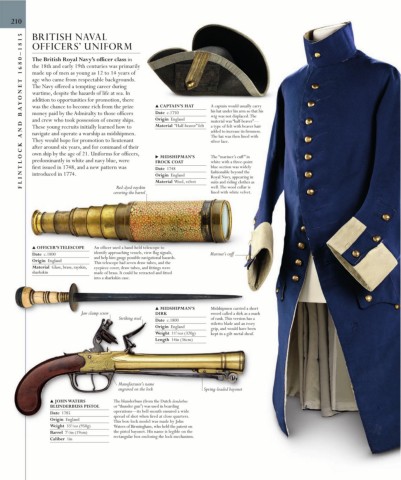
         Y  The Navy offered a tempting career during   ▲ CAPTAIN’S HAT     A captain would usually carry
            was the chance to become rich from the prize
         AND BA  and crew who took possession of enemy ships.   Origin  England  wig was not displaced. The
                                                                            his hat under his arm so that his
                                                        Date  c.1750
            money paid by the Admiralty to those officers
                                                                            material was “half-beaver”—
                                                        Material  “Half-beaver” felt
                                                                            a type of felt with beaver hair
            These young recruits initially learned how to
                                                                            added to increase its firmness.
            navigate and operate a warship as midshipmen.
                                                                            The hat was then lined with
            They would hope for promotion to lieutenant
         FLINTLOCK   after around six years, and for command of their   ▶ MIDSHIPMAN’S   The “mariner’s cuff” in
                                                                            silver lace.
            own ship by the age of 21. Uniforms for officers,
            predominantly in white and navy blue, were
                                                                            white with a three-point
                                                        FROCK COAT
            first issued in 1748, and a new pattern was
                                                                            blue section was widely
                                                        Date  1748
                                                                            fashionable beyond the
            introduced in 1774.
                                                        Origin  England
                                                                            Royal Navy, appearing in
                                                                            well. The wool collar is
                                          Red-dyed rayskin
                                                                            lined with white velvet.
                                         covering the barrel  Material  Wool, velvet  suits and riding clothes as
            ▲ OFFICER’S TELESCOPE  An officer used a hand-held telescope to
            Date  c.1800          identify approaching vessels, view flag signals,    Mariner’s cuff
                                  and help him gauge possible navigational hazards.
            Origin  England       This telescope had seven draw tubes, and the
            Material  Glass, brass, rayskin,   eyepiece cover, draw tubes, and fittings were
            sharkskin             made of brass. It could be retracted and fitted
                                  into a sharkskin case.


                                                        ▲ MIDSHIPMAN’S      Midshipmen carried a short
                              Jaw clamp screw           DIRK                sword called a dirk as a mark
                                           Striking steel                   of rank. This version has a
                                                        Date  c.1800
                                                                            stiletto blade and an ivory
                                                        Origin  England
                                                                            grip, and would have been
                                                                1
                                                        Weight  11 ⁄4oz (320g)  kept in a gilt-metal sheaf.
                                                        Length  14in (36cm)


                                           Manufacturer’s name
                                           engraved on the lock           Spring-loaded bayonet

                   ▲ JOHN WATERS         The blunderbuss (from the Dutch donderbus
                   BLUNDERBUSS PISTOL    or “thunder gun”) was used in boarding
                   Date  1785            operations—its bell-mouth ensured a wide
                                         spread of shot when fired at close quarters.
                   Origin  England
                                         This box-lock model was made by John
                          1
                   Weight  33 ⁄2oz (950g)  Waters of Birmingham, who held the patent on
                         1
                   Barrel  7 ⁄2in (19cm)  the pistol bayonet. His name is legible on the
                                         rectangular box enclosing the lock mechanism.
                   Caliber  1in

