


Page 209 - (DK) Smithsinian - Military History: The Definitive Visual Guide to the Objects of Warfare
P. 209
207

                                                               NAVAL COMBAT IN THE AGE OF SAIL
                                                               THE BATTLE                                                               THE BA


                                                               OF THE NILE


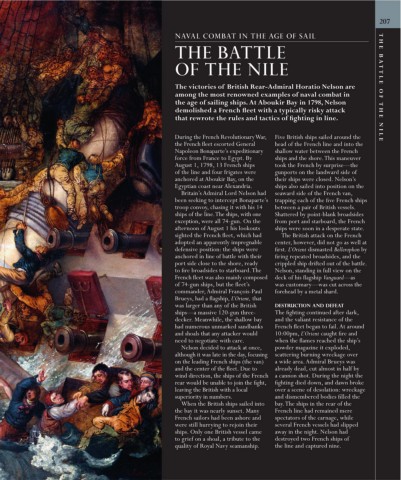
                                                               The victories of  British Rear-Admiral Horatio Nelson are
                                                               among the most renowned examples of naval combat in
                                                               the age of sailing ships. At Aboukir Bay in 1798, Nelson                 TTLE OF  THE NILE
                                                               demolished a French fleet with a typically risky attack
                                                               that rewrote the rules and tactics of fighting in line.


                                                               During the French Revolutionary War,   Five British ships sailed around the
                                                               the French fleet escorted General   head of the French line and into the
                                                               Napoleon Bonaparte’s expeditionary   shallow water between the French
                                                               force from France to Egypt. By      ships and the shore. This maneuver
                                                               August 1, 1798, 13 French ships     took the French by surprise—the
                                                               of the line and four frigates were   gunports on the landward side of
                                                               anchored at Aboukir Bay, on the     their ships were closed. Nelson’s
                                                               Egyptian coast near Alexandria.     ships also sailed into position on the
                                                                  Britain’s Admiral Lord Nelson had   seaward side of the French van,
                                                               been seeking to intercept Bonaparte’s  trapping each of the five French ships
                                                               troop convoy, chasing it with his 14   between a pair of British vessels.
                                                               ships of the line. The ships, with one   Shattered by point-blank broadsides
                                                               exception, were all 74-gun. On the   from port and starboard, the French
                                                               afternoon of August 1 his lookouts   ships were soon in a desperate state.
                                                               sighted the French fleet, which had   The British attack on the French
                                                               adopted an apparently impregnable   center, however, did not go as well at
                                                               defensive position: the ships were   first. L’Orient dismasted Bellerophon by
                                                               anchored in line of battle with their   firing repeated broadsides, and the
                                                               port side close to the shore, ready    crippled ship drifted out of the battle.
                                                               to fire broadsides to starboard. The   Nelson, standing in full view on the
                                                               French fleet was also mainly composed  deck of his flagship Vanguard—as
                                                               of 74-gun ships, but the fleet’s    was customary—was cut across the
                                                               commander, Admiral François-Paul    forehead by a metal shard.
                                                               Brueys, had a flagship, L’Orient, that
                                                               was larger than any of the British   DESTRUCTION AND DEFEAT
                                                               ships—a massive 120-gun three-      The fighting continued after dark,
                                                               decker. Meanwhile, the shallow bay   and the valiant resistance of the
                                                               had numerous unmarked sandbanks     French fleet began to fail. At around
                                                               and shoals that any attacker would   10:00pm, L’Orient caught fire and
                                                               need to negotiate with care.        when the flames reached the ship’s
                                                                  Nelson decided to attack at once,   powder magazine it exploded,
                                                               although it was late in the day, focusing  scattering burning wreckage over
                                                               on the leading French ships (the van)   a wide area. Admiral Brueys was
                                                               and the center of the fleet. Due to   already dead, cut almost in half by
                                                               wind direction, the ships of the French  a cannon shot. During the night the
                                                               rear would be unable to join the fight,   fighting died down, and dawn broke
                                                               leaving the British with a local    over a scene of desolation: wreckage
                                                               superiority in numbers.             and dismembered bodies filled the
                                                                  When the British ships sailed into   bay. The ships in the rear of the
                                                               the bay it was nearly sunset. Many   French line had remained mere
                                                               French sailors had been ashore and   spectators of the carnage, while
                                                               were still hurrying to rejoin their   several French vessels had slipped
                                                               ships. Only one British vessel came    away in the night. Nelson had
                                                               to grief on a shoal, a tribute to the   destroyed two French ships of
                                                               quality of Royal Navy seamanship.   the line and captured nine.

