


Page 213 - (DK) Smithsinian - Military History: The Definitive Visual Guide to the Objects of Warfare
P. 213
211


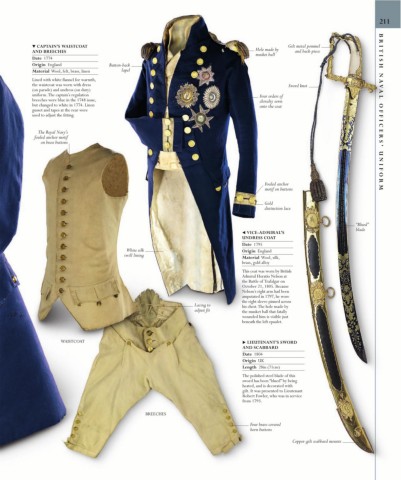
            ▼ CAPTAIN’S  WAISTCOAT                                                                      Gilt metal pommel
            AND BREECHES                                                                    Hole made by   and back-piece
                                                                                            musket ball
            Date  1774
            Origin  England             Button-back
            Material  Wool, felt, brass, linen  lapel
            Lined with white flannel for warmth,
            the waistcoat was worn with dress                                                           Sword knot
            (on parade) and undress (on duty)                                                                                           BRITISH NA V AL OFFICERS’
            uniform. The captain’s regulation                                                 Four orders of
            breeches were blue in the 1748 issue,                                             chivalry sewn
            but changed to white in 1774. Linen                                               onto the coat
            gusset and tapes at the rear were
            used to adjust the fitting.


              The Royal Navy’s
             fouled anchor motif
               on brass buttons


                                                                                               Fouled anchor                             UNIFORM
                                                                                               motif on buttons

                                                                                               Gold
                                                                                               distinction lace


                                                                                                                                “Blued”
                                                                                                                                blade
                                                                                       ◀ VICE-ADMIRAL’S
                                                                                       UNDRESS COAT
                                                                                       Date  1795
                                              White silk                               Origin  England
                                             twill lining
                                                                                       Material  Wool, silk,
                                                                                       brass, gold alloy
                                                                                       This coat was worn by British
                                                                                       Admiral Horatio Nelson at
                                                                                       the Battle of  Trafalgar on
                                                                                       October 21, 1805. Because
                                                                                       Nelson’s right arm had been
                                                                                       amputated in 1797, he wore
                                                                                       the right sleeve pinned across
                                                                      Lacing to        his chest. The hole made by
                                                                      adjust fit       the musket ball that fatally
                                                                                       wounded him is visible just
                                                                                       beneath the left epaulet.


                       WAISTCOAT                                                       ▶ LIEUTENANT’S SWORD
                                                                                       AND SCABBARD
                                                                                       Date  1804
                                                                                       Origin  UK
                                                                                       Length  28in (71cm)
                                                                                       The polished steel blade of this
                                                                                       sword has been “blued” by being
                                                                                       heated, and is decorated with
                                                                                       gilt. It was presented to Lieutenant
                                                                                       Robert Fowler, who was in service
                                                                                       from 1793.

                                                     BREECHES
                                                                                          Four brass-covered
                                                                                          horn buttons

                                                                                                         Copper-gilt scabbard mounts

