


Page 248 - (DK) Smithsinian - Military History: The Definitive Visual Guide to the Objects of Warfare
P. 248
246

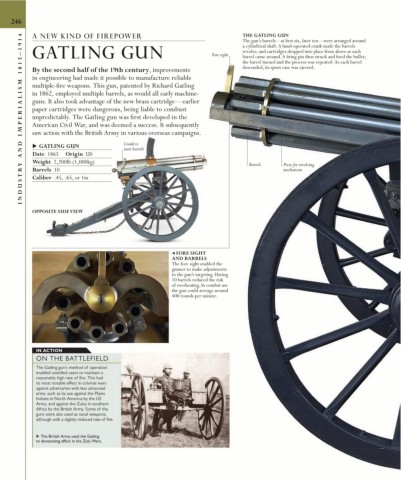
            A NEW KIND OF FIREPOWER                                                    THE GATLING GUN
         AND IMPERIALISM 1815–1914
                                                                                       The gun’s barrels—at first six, later ten—were arranged around
            GATLING GUN                                                      Fore sight  a cylindrical shaft. A hand-operated crank made the barrels
                                                                                       revolve, and cartridges dropped into place from above as each
                                                                                       barrel came around. A firing pin then struck and fired the bullet;
                                                                                       the barrel turned and the process was repeated. As each barrel
            By the second half of the 19th century, improvements                       descended, its spent case was ejected.
            in engineering had made it possible to manufacture reliable
            multiple-fire weapons. This gun, patented by Richard Gatling
            in 1862, employed multiple barrels, as would all early machine-
            guns. It also took advantage of the new brass cartridge—earlier
            paper cartridges were dangerous, being liable to combust
            unpredictably. The Gatling gun was first developed in the
            American Civil War, and was deemed a success. It subsequently
            saw action with the British Army in various overseas campaigns.

            ▶ GATLING GUN                    Crank to
                                             turn barrels
            Date  1865     Origin  US
         Y   Weight  2,200lb (1,000kg)                                                    Barrels     Pivot for revolving
            Barrels  10
                                                                                                      mechanism
         INDUSTR  Caliber  .45, .65, or 1in


            OPPOSITE SIDE VIEW


                                                              ◀ FORE SIGHT
                                                              AND BARRELS
                                                              The fore sight enabled the
                                                              gunner to make adjustments
                                                              to the gun’s targeting. Having
                                                              10 barrels reduced the risk
                                                              of overheating. In combat use
                                                              the gun could average around
                                                              400 rounds per minute.


              IN ACTION
              ON THE BATTLEFIELD
              The Gatling gun’s method of operation
              enabled unskilled users to maintain a
              reasonably high rate of fire. This had
              its most notable effect in colonial wars
              against adversaries with less advanced
              arms, such as its use against the Plains
              Indians in North America by the US
              Army, and against the Zulus in southern
              Africa by the British Army. Some of the
              guns were also used as naval weapons,
              although with a slightly reduced rate of fire.


              ▶ The British Army used the Gatling
              to devastating effect in the Zulu Wars.

