


Page 253 - (DK) Smithsinian - Military History: The Definitive Visual Guide to the Objects of Warfare
P. 253
251

                                                               IMPERIAL FIREPOWER
                                                               THE BATTLE                                                               THE BA


                                                               OF OMDURMAN


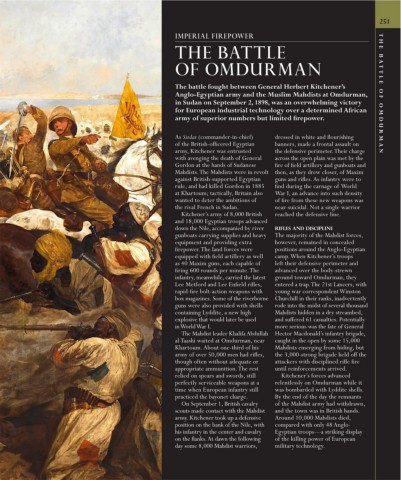
                                                               The battle fought between General Herbert Kitchener’s
                                                               Anglo-Egyptian army and the Muslim Mahdists at Omdurman,
                                                               in Sudan on September 2, 1898, was an overwhelming victory
                                                               for European industrial technology over a determined African             TTLE OF OMDURMAN
                                                               army of superior numbers but limited firepower.


                                                               As Sirdar (commander-in-chief)      dressed in white and flourishing
                                                               of the British-officered Egyptian   banners, made a frontal assault on
                                                               army, Kitchener was entrusted       the defensive perimeter. Their charge
                                                               with avenging the death of General   across the open plain was met by the
                                                               Gordon at the hands of Sudanese     fire of field artillery and gunboats and
                                                               Mahdists. The Mahdists were in revolt  then, as they drew closer, of Maxim
                                                               against British-supported Egyptian   guns and rifles. As infantry were to
                                                               rule, and had killed Gordon in 1885   find during the carnage of  World
                                                               at Khartoum; tactically, Britain also   War I, an advance into such density
                                                               wanted to deter the ambitions of    of fire from these new weapons was
                                                               the rival French in Sudan.          near-suicidal. Not a single warrior
                                                                  Kitchener’s army of 8,000 British   reached the defensive line.
                                                               and 18,000 Egyptian troops advanced
                                                               down the Nile, accompanied by river   RIFLES AND DISCIPLINE
                                                               gunboats carrying supplies and heavy   The majority of the Mahdist forces,
                                                               equipment and providing extra       however, remained in concealed
                                                               firepower. The land forces were     positions around the Anglo-Egyptian
                                                               equipped with field artillery as well   camp. When Kitchener’s troops
                                                               as 40 Maxim guns, each capable of   left their defensive perimeter and
                                                               firing 600 rounds per minute. The   advanced over the body-strewn
                                                               infantry, meanwhile, carried the latest   ground toward Omdurman, they
                                                               Lee Metford and Lee Enfield rifles,   entered a trap. The 21st Lancers, with
                                                               rapid-fire bolt-action weapons with   young war correspondent Winston
                                                               box magazines. Some of the riverborne  Churchill in their ranks, inadvertently
                                                               guns were also provided with shells   rode into the midst of several thousand
                                                               containing Lyddite, a new high      Mahdists hidden in a dry streambed,
                                                               explosive that would later be used    and suffered 61 casualties. Potentially
                                                               in World War I.                     more serious was the fate of General
                                                                  The Mahdist leader Khalifa Abdullah  Hector Macdonald’s infantry brigade,
                                                               al-Taashi waited at Omdurman, near   caught in the open by some 15,000
                                                               Khartoum. About one-third of his    Mahdists emerging from hiding, but
                                                               army of over 50,000 men had rifles,   the 3,000-strong brigade held off the
                                                               though often without adequate or    attackers with disciplined rifle fire
                                                               appropriate ammunition. The rest    until reinforcements arrived.
                                                               relied on spears and swords, still    Kitchener’s forces advanced
                                                               perfectly serviceable weapons at a    relentlessly on Omdurman while it
                                                               time when European infantry still   was bombarded with Lyddite shells.
                                                               practiced the bayonet charge.       By the end of the day the remnants
                                                                  On September 1, British cavalry   of the Mahdist army had withdrawn,
                                                               scouts made contact with the Mahdist   and the town was in British hands.
                                                               army. Kitchener took up a defensive   Around 10,000 Mahdists died,
                                                               position on the bank of the Nile, with   compared with only 48 Anglo-
                                                               his infantry in the center and cavalry   Egyptian troops—a striking display
                                                               on the flanks. At dawn the following   of the killing power of European
                                                               day some 8,000 Mahdist warriors,    military technology.

