


Page 272 - (DK) Smithsinian - Military History: The Definitive Visual Guide to the Objects of Warfare
P. 272
270

            EARLY CRUISERS
         AND IMPERIALISM 1815–1914
            Prior to the 1880s, the term “cruiser” was not recognized as
            a single group of ships, being composed of frigates, corvettes,
            and sloops. By the 1890s, however, the new class had taken on a
            well-defined identity of its own. Capable of long-range action                                           Square
                                                                                                                     sail on
            independently of battle fleets, cruisers were able to engage in                                          foremast
            commerce raiding or to protect national interests in far-flung
            places. By the turn of the century, cruisers had become the
            single largest class of warship in service; some navies never
            commissioned a more powerful, or modern, vessel.


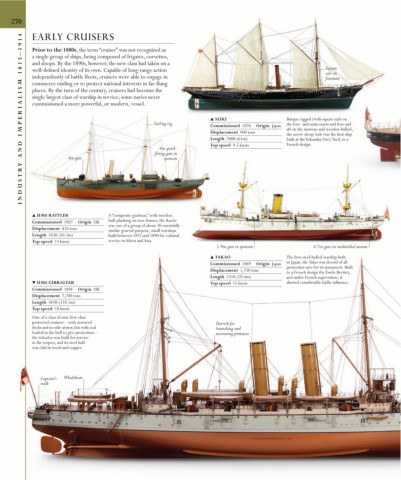
                                                                            ▲ SEIKI                    Barque-rigged (with square sails on
                                                        Sailing rig                                    the fore- and main masts and fore and
                                                                            Commissioned  1876     Origin  Japan
                                                                                                       aft on the mizzen) and wooden-hulled,
                                                                            Displacement  900 tons     the screw-sloop Seiki was the first ship
                                                                            Length  200ft (61m)        built at the Yokosuka Navy  Yard, to a
                                                                            Top speed  9.5 knots       French design.
                                                          4in quick-
                                                        firing gun in
                         4in gun                           sponson
         Y
         INDUSTR


            ▲ HMS RATTLER               A “composite gunboat,” with wooden
            Commissioned  1887     Origin  UK  hull-planking on iron frames, the Rattler
                                        was one of a group of about 30 essentially
            Displacement  810 tons
                                        similar general-purpose, small warships
            Length  165ft (50.3m)       built between 1875 and 1890 for colonial
            Top speed  13 knots         service in Africa and Asia.
                                                                              5.9in gun in sponson               4.7in gun on unshielded mount
                                                                            ▲ TAKAO                    The first steel-hulled warship built
                                                                            Commissioned  1889     Origin  Japan  in Japan, the Takao was devoid of all
                                                                                                       protection save for its armament. Built
                                                                            Displacement  1,750 tons   to a French design (by Émile Bertin),
                                                                            Length  231ft (70.4m)      and under French supervision, it
            ▼ HMS GIBRALTAR                                                 Top speed  15 knots        showed considerable Gallic influence.
            Commissioned  1894     Origin  UK
            Displacement  7,700 tons
            Length  387ft (118.1m)
            Top speed  18 knots
            One of a class of nine first-class
            protected cruisers—with armored                                   Derrick for
            decks and no side-armor, but with coal                            launching and
            loaded in the hull to give protection—                            recovering pinnaces
            the Gibraltar was built for service
            in the tropics, and its steel hull
            was clad in wood and copper.


               Captain’s    Whaleboat
               walk

