


Page 274 - (DK) Smithsinian - Military History: The Definitive Visual Guide to the Objects of Warfare
P. 274
272

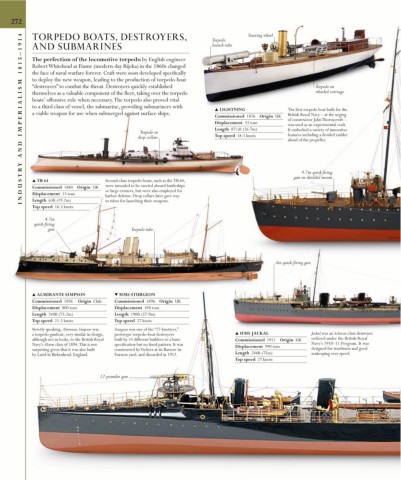
            TORPEDO BOATS, DESTROYERS,                                       Torpedo     Steering wheel
         AND IMPERIALISM 1815–1914
            AND SUBMARINES                                                   launch tube

            The perfection of the locomotive torpedo by English engineer
            Robert Whitehead at Fiume (modern-day Rijeka) in the 1860s changed
            the face of naval warfare forever. Craft were soon developed specifically
            to deploy the new weapon, leading to the production of torpedo-boat
            “destroyers” to combat the threat. Destroyers quickly established                                    Torpedo on
            themselves as a valuable component of the fleet, taking over the torpedo                             wheeled carriage
            boats’ offensive role when necessary. The torpedo also proved vital
            to a third class of vessel, the submarine, providing submariners with    ▲ LIGHTNING        The first torpedo boat built for the
            a viable weapon for use when submerged against surface ships.                               British Royal Navy—at the urging
                                                                              Commissioned  1876    Origin  UK
                                                                                                        of constructor John Thornycroft—
                                                                              Displacement  33 tons     was used as an experimental craft.
                                                                              Length  87½ft (26.7m)     It embodied a variety of innovative
                                                   Torpedo in                                           features including a divided rudder
                                                  drop collars                Top speed  18.5 knots
                                                                                                        ahead of the propeller.


         Y                                                                                                  4.7in quick firing
         INDUSTR  ▲ TB 64             Second-class torpedo boats, such as the  TB 64,                     gun on shielded mount


                                      were intended to be carried aboard battleships
            Commissioned  1880    Origin  UK
                                      or large cruisers, but were also employed for
            Displacement  13 tons
                                      harbor defense. Drop collars later gave way
            Length  63ft (19.2m)
            Top speed  16.5 knots     to tubes for launching their weapons.
                 4.7in
             quick-firing
                  gun                           Torpedo tube


                                                                                                   4in quick-firing gun


            ▲ ALMIRANTE SIMPSON           ▼ HMS STURGEON
            Commissioned  1896     Origin  Chile  Commissioned  1896    Origin  UK
            Displacement  800 tons        Displacement  340 tons
            Length  240ft (73.2m)         Length  190ft (57.9m)
            Top speed  21.5 knots         Top speed  27 knots
            Strictly speaking, Almirante Simpson was   Sturgeon was one of the “27-knotters,”
            a torpedo gunboat, very similar in design,   prototype torpedo-boat destroyers    ▲ HMS JACKAL      Jackal was an Acheron-class destroyer
            although not in looks, to the British Royal   built by 14 different builders to a basic   Commissioned  1911    Origin  UK  ordered under the British Royal
            Navy’s Alarm-class of 1894. This is not   specification but no fixed pattern. It was   Displacement  990 tons  Navy’s 1910–11 Program. It was
            surprising given that it was also built    constructed by Vickers at its Barrow-in-                 designed for sturdiness and good
            by Laird in Birkenhead, England.   Furness yard, and discarded in 1912.  Length  246ft (75m)        seakeeping over speed.
                                                                                     Top speed  27 knots


                                     12-pounder gun

