


Page 28 - (DK) Smithsinian - Military History: The Definitive Visual Guide to the Objects of Warfare
P. 28
26

         CE  HOPLITE ARMOR AND WEAPONS
         O 500  For four centuries from 700BCE, heavily armed citizen-soldiers

            called hoplites (“armed men”) formed the armies of the Greek city-states.
            Each soldier typically provided all of his weaponry and armor at his
         ORDS   T  own expense: a bronze corselet (made up of a bell-shaped breastplate
            and backplate), a helmet, greaves, a sword, a spear, and a large round
            shield. Fighting in tightly packed phalanxes, the soldiers were very
            well protected, although still vulnerable to spear-thrusts around the
            groin and throat, or to wounds inflicted by missiles before they closed
         AND SW  in on the opposing army’s line.


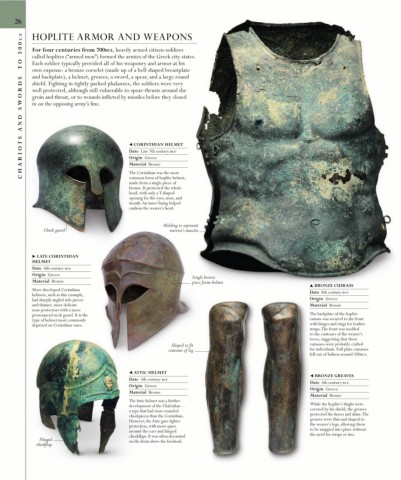
         TS                                    ◀ CORINTHIAN HELMET
         CHARIO                                Date  Late 7th century bce
                                               Origin  Greece
                                               Material  Bronze
                                               The Corinthian was the most
                                               common form of hoplite helmet,
                                               made from a single piece of
                                               bronze. It protected the whole
                                               head, with only a  T-shaped
                                               opening for the eyes, nose, and
                                               mouth. An inner lining helped
                                               cushion the wearer’s head.


                                                           Molding to represent
                Cheek guard                                  warrior’s muscles


            ▶ LATE CORINTHIAN
            HELMET
            Date  6th century bce
            Origin  Greece
                                                                     Single bronze
            Material  Bronze                                         piece forms helmet
                                                                                                               ▲ BRONZE CUIRASS
            More developed Corinthian
            helmets, such as this example,                                                                     Date  8th century bce
            had sharply angled side pieces                                                                     Origin  Greece
            and thinner, more delicate                                                                         Material  Bronze
            nose protectors with a more
            pronounced neck guard. It is the                                                                   The backplate of the hoplite
            type of helmet most commonly                                                                       cuirass was secured to the front
            depicted on Corinthian vases.                                                                      with hinges and rings for leather
                                                                                                               straps. The front was molded
                                                                                                               to the contours of the wearer’s
                                                                                                               torso, suggesting that these
                                                              Shaped to fit                                    cuirasses were probably crafted
                                                             contours of leg                                   for individuals. Full plate cuirasses
                                                                                                               fell out of fashion around 500bce.

                                               ◀ ATTIC HELMET
                                                                                                                ◀ BRONZE GREAVES
                                               Date  5th century bce
                                                                                                                Date  6th century bce
                                               Origin  Greece
                                                                                                                Origin  Greece
                                               Material  Bronze
                                                                                                                Material  Bronze
                                               The Attic helmet was a further
                                               development of the Chalcidian—                                   While the hoplite’s thighs were
                                               a type that had more rounded                                     covered by his shield, the greaves
                                               cheekpieces than the Corinthian.                                 protected the knees and shins. The
                                               However, the Attic gave lighter                                  greaves were thin and shaped to
                                               protection, with more space                                      the wearer’s legs, allowing them
                                               around the ears and hinged                                       to be snapped into place without
                                               cheekflaps. It was often decorated                               the need for straps or ties.
               Hinged                          on the front above the forehead.
              cheekflap

